‘Nursing is not just a career, it has a world of possibilities’
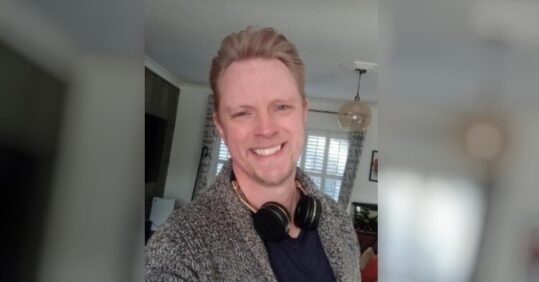


Advanced nurse practitioner (ANP) Thomas Buckley says nurses need to ‘scream and shout’ about their roles, as he advocates for nursing as a ‘great opportunity’ with a ‘world of possibilities’. Mr Buckley spotlights the role of ANPs, advocating for better awareness of their jobs as well as encouraging more men to join the profession. This article comes as part of Nursing in Practice’s How Nurses Count campaign, which aims to champion nursing expertise and innovation.
Securing better recognition for the role of ANPs and the variety of skills required for the role are among Mr Buckley’s key hopes for the profession.
An ANP at a GP practice in Hove, Mr Buckley says: ‘I think we have a huge workload and I’m very fortunate that I think the doctors I work with do recognise what I do, but I still think there’s still lots of work to do.
‘There is a lot of misinformation out there about what ANPs do and what we bring to the table, and I’d like to see changes there.’
Though he adds: ‘I think general practice has a better view on ANPs, because with we’re more established in that.’
Mr Buckley hopes to spotlight the role of ANPs and the skills needed in the role, as well as highlighting it as a job with a lot of possibilities.
He first qualified as a nurse from Brighton University in 2012 and for the first six months of his career worked in A&E before moving into community nursing.
‘I think if I’m honest, I fell into nursing,’ he says. ‘The more I’ve grown with the profession, the more I have realised that it’s a brilliant career.
‘There’s so many different avenues, and you can almost see that from my portfolio career, it’s built me up to who I am and where I am today.’
He completed a specialist public health degree and became a school nurse for two years in London.
Related Article: How a nurse-led community mental health hub is improving patient care and access
Following a stint travelling, he began working for the he began working for what was then his local clinical commissioning group (CCG), with a project focused on improving the uptake of men in practice nursing.
Recognising that nursing is a female-dominated profession, Mr Buckley says he hopes more men see it as a career too.
‘There are so many career opportunities, it is a career for everyone,’ he says.
‘It’s not just a career, it’s about saying that there is a world of possibilities within nursing. It doesn’t have to be that you do your course and you end up in hospital.
‘You can come into general practice. You can come into community, you can go into research.’
Mr Buckley, who has a specialist background in diabetes, continued to do clinical practice studying and became a diabetes specialist nurse at Chelsea in Westminster Hospital.
‘Then I decided I wanted to come out of the NHS completely, because I felt a bit burnt out,’ he says.
He went on to work at a private school, teaching the preliminary SAT programme and sports before moving out of London to do some patient safety work within the Sussex community.
After completing his Master’s modules towards advanced practice, Mr Buckley became an ANP and is currently working at Trinity Medical Centre in East Sussex.
‘I have always felt that there was more opportunity in primary care,’ he says. ‘I think there’s one hand of my role that is proactive, and there’s a public health opportunity, and there’s another hand which is reactive, trying to address someone’s problem.
‘I think there’s a lot of opportunities in terms of support, education, and growth.’
Describing his day-to-day, Mr Buckley says the type of work he does is broad.
He says: ‘Sometimes it’s speaking to specialist colleagues in the hospital setting, taking blood, reviewing them when they come back, sending people for imaging.
‘Or it can be seeing a complex diabetic patient who I’ve got good rapport with that comes to see me every two to three weeks, and it’s a really positive conversation because we’re looking at good trends and their blood results and things are going well.’
Part of Mr Buckley’s role is also completing ward rounds at a care home. Care home managers will identify residents they are concerned about for Mr Buckley to check on, ranging from residents who may have an acute cough, or those who have fallen and have sustained head injuries.
‘Every day is different,’ he says. ‘It’s the same principle, but the difference of frailty is you look at rationalising medication rather than adding it where possible, because there’s so many more risks with giving medication to people that are older.’
Due to the wide variety of tasks, Mr Buckley compares the skills needed of an ANP as similar to that of a detective.
Related Article: More than half of GPNs report working while feeling mentally unwell, finds survey
He says: ‘I think you need really need to be quite good at your critical reasoning and clear documentation, especially when you’re working in an advanced clinical role because you’re making autonomous decisions, which is very huge responsibility.
‘When you’ve got undifferentiated patients that you’re diagnosing, it’s an amalgamation of a lot of things.
‘You need to make sure you’re keeping up to date with everything, which can be extremely difficult when health guidelines change all the time, and then you’ve got your clinical practice and making sure that you’re always doing courses to keep yourself up to date.’
He adds that prescribing is a big part of the ANP role and it needs to be done safely and appropriately.
The variety of his tasks is one of the things Mr Buckley enjoys the most about his job, saying that ‘no day is boring’ and nurses meet people ‘from all walks of life’.
‘You could have anyone can come into your clinic,’ he says. ‘I’m not saying if it’s true or not, but you could have a celebrity that walks in, and then the next minute, you have someone that’s from a really deprived area that has lots of social complexities as well as health issues.
‘So, you’re seeing the whole picture. You’re not trying to just deal with the health need, sometimes health is also folded into social needs as well.’
Mr Buckley adds that another part of his jobs that he finds ‘beautiful’ is the roles he completes in the care home.
He says: ‘It’s about those butterfly moments for someone that’s losing their memory, I can sit there and I can make them smile and talk about something.’
Despite the fulfilment and variety he finds from his role, Mr Buckley is concerned there is not enough awareness about what ANPs do, or of roles in general practice.
He explains he ‘stumbled’ on general practice ‘accidentally’. He says: ‘I think people have a slight caution to it but it’s just about opening up those conversations and finding out what’s available rather than closing doors.
‘I think with an ageing workforce, more people need to come into general practice. And there is a funding opportunity here for the government, because they want more community-based care and less people in hospitals.
Related Article: Practice nurses call for Agenda for Change terms and conditions to ‘feel safer’
‘So, if there’s ever going to be a time to come into it, it’s now.’
He adds: ‘I think my key thing is advocating for advanced practitioners. I think it is a great opportunity, and shouldn’t be seen as some boring career, because it certainly isn’t.
‘Nurses are great, all healthcare professionals are great, but I think nurses need to scream and shout about it because I feel like there’s a lot of muddied news.’
Nursing in Practice’s How Nurses Count campaign aims not only to encourage nurses across primary and community care to share best practice and learn from one another, but also to ensure that their collective voice is recognised at the highest levels.
Please get in touch with editor Megan Ford ([email protected]) or senior reporter Gee Harland ([email protected]), to be involved in our campaign and share how you count.

See how our symptom tool can help you make better sense of patient presentations
Click here to search a symptom