Bowel cancer – the role of nurses in improving early diagnosis


Bowel cancer represents the second leading cause of cancer mortality in the UK, with approximately 17,700 deaths recorded annually. However, early diagnosis dramatically improves survival rates, with over nine in ten patients surviving five years or more when diagnosed at the earliest stage.
April is Bowel Cancer Awareness Month and Dr Claire Coughlan RN explores how community and practice nurses are uniquely placed to help drive earlier diagnosis and save more lives.
Bowel cancer is the fourth most common cancer in the UK,1 and the second biggest cancer killer. It is a treatable and curable cancer, especially if diagnosed early. However, the symptoms are often non-specific or non-existent, leading many patients to be diagnosed in emergency settings when their cancer is at a later stage.
Through greater awareness of bowel cancer, community and practice nurses can play a vital role in making sure it’s diagnosed early and ultimately saving more lives.
Prevalence and impact
Every 12 minutes, someone in the UK receives a diagnosis of bowel cancer – equating to 120 people a day. It affects men more often than women, with one in 17 men and one in 20 women receiving a diagnosis during their lifetime.2
Related Article: Lower gastrointestinal symptoms – supporting earlier diagnosis
Around 17,700 people in the UK die from bowel cancer each year, but it doesn’t need to be this way. Most people – over nine in 10 people – survive bowel cancer for five years or more if it is diagnosed at the earliest stage.3 Unfortunately, fewer than four in 10 people are diagnosed in the early stages (stages one and two), while almost half are diagnosed in the later stages (stages three and four).4 This makes improvements in early diagnosis crucial.
Given their close involvement with patients, community and practice nurses are ideally placed to spot patterns that can lead to patients being referred for investigation for bowel cancer sooner, if they can recognise the symptoms.
Symptoms to watch out for
Rectal bleeding is a common symptom of bowel cancer. Unfortunately, this symptom can be caused by many other conditions, such as haemorrhoids, fissures and polyps, which makes diagnosing the disease through this symptom alone a challenge.
Changes in bowel habits such as diarrhoea, constipation, tenesmus – a persistent urge to defecate, even when bowels are empty – and changes in frequency of bowel movements are also causes for concern if they persist for three weeks or more. These symptoms should prompt further investigations and swift referral if indicated.5
Bowel cancer can also be signified by pain or a mass in a patient’s abdomen, fatigue, and iron deficiency anaemia. A primary care nurse physically examining a patient’s abdomen, or spotting low haemoglobin in a patient’s blood, could help identify the presence of bowel cancer.
Recognising bowel cancer symptoms can be challenging with many symptoms being common with less serious conditions, or patients being reluctant to talk about their symptoms due to the perceived stigma around them. Primary care nurses are well placed to address the stigma around bowel symptoms and normalise completing tests.
The quantitative faecal immunochemical test (FIT) helps primary care professionals manage patients with suspected bowel cancer symptoms.6 The FIT used in primary care with symptomatic patients has a sensitivity of 10μg/g.
If a patient presents with red flag symptoms like those mentioned above or signs such as a FIT above 10μg/g, an abdominal mass or anaemia, primary care professionals should complete an urgent suspected cancer referral.
Related Article: Recognising the signs of secondary breast cancer
Bowel cancer screening: uptake and disparities
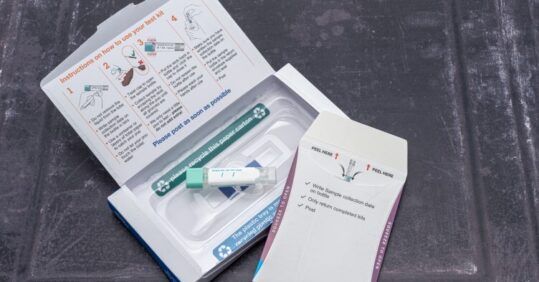
Bowel cancer screening is offered to people aged 50 to 74 in England, Scotland and Wales, with people registered with a GP automatically sent a bowel cancer screening home FIT test kit through the post every two years.7 Screening is offered to people aged between 60 and 74 in Northern Ireland.8
The FIT is used within early detection screening programmes at a sensitivity of 80μg/g in England, Scotland and Wales and 120μg/g in Northern Ireland. The sensitivity of the FIT for patients presenting with symptoms in primary care is set at 10μg/g, which is significantly lower than the bowel cancer screening programme. It is, therefore, important that if a patient presents with symptoms but has had a recent negative bowel cancer screening test, they are still offered a FIT in primary care.
Screening uptake across the UK is improving but remains inconsistent. England has the highest average of eligible people taking part in screening (70.3%) compared to other UK nations: Scotland (65.7%), Wales (65.5%) and Northern Ireland (67.3%).9
There are also significant variations in uptake between different areas in England. In the least deprived areas in England (lowest 20% for deprivation), screening uptake in 2023–24 was 75.8%, compared with just 55.8% in the most deprived areas (highest 20% for deprivation).10
Recent screening extension
In January 2025, the NHS completed a phased rollout in England which lowered the starting age for bowel cancer screening eligibility from 60 to 50.11 This made around 850,000 additional people in England a year eligible for the screening test.
However, figures show that screening uptake remains lower in people aged 54 to 59 – with less than 60% of 54–57-year-olds returning their FIT kits, compared with over 70% in the 60–74 age range.11
Related Article: Hormone patches effectively control advanced prostate cancer, study finds
Nurses should encourage patients to take part in screening and complete their home kits to ensure that as many of them as possible benefit from the expanded screening programme.
Key takeaways
- Over 46,000 people are diagnosed with bowel cancer in the UK every year.
- Community and practice nurses who know the signs and symptoms of bowel cancer can help patients to be diagnosed when their cancer is at an earlier stage.
- Providing bowel cancer patients with the early, expert support they need can not only make a huge difference to their lives but also give them a better chance of long-term survival.
Dr Claire Coughlan is a registered nurse and the clinical lead at Bowel Cancer UK.
References
- Cancer Research UK. UK bowel cancer stats at a glance.
- Cancer Research UK. Bowel cancer statistics.
- Cancer Research UK. Nine in ten survive early stage bowel cancer.
- NICE. Suspected cancer: recognition and referral: recommended actions organised by symptom and findings of primary care investigations. [NG12] Last updated April 2026
- Cancer Research UK. Faecal Immunochemical Test (FIT).
- NHS UK. Bowel cancer screening.
- NI Direct. Bowel cancer screening.
- Bowel Cancer UK. A third of people in the UK don’t complete their bowel cancer screening test. March 2026
- UK National Screening Committee. Wealth of evidence highlights the benefits of bowel cancer screening. April 2025
- Bowel Cancer UK. The bowel cancer screening age has been lowered to 50 in England. January 2025

See how our symptom tool can help you make better sense of patient presentations
Click here to search a symptom