Details of incoming chickenpox vaccination programme released
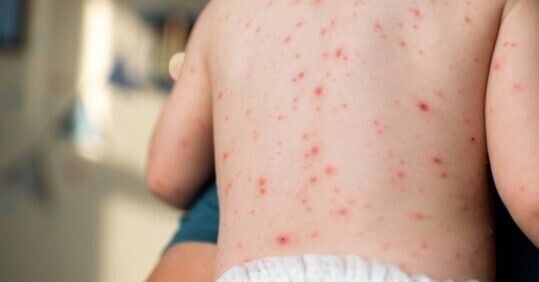


Key information on the implementation of a new chickenpox vaccination programme – including eligibility, funding and vaccine supply – has been released by the government.
From 1 January 2026, a routine varicella vaccination programme will be introduced for children at one year and at 18 months, with a catch-up programme for children aged up to six years also to be launched later in the year.
The change will see all children across England offered a combined MMRV vaccine instead of measles, mumps and rubella vaccine (MMR) as part of the childhood routine two-dose vaccination schedule at GP practices.
The government has confirmed in a letter published last week that the routine schedule will see:
- Two doses of MMRV offered to children aged under one year old on 31 December 2025 (date of birth on or after 1 January 2025): dose 1 at one year, and dose 2 at a new 18-month appointment
- Two doses of MMRV offered to children aged from one year up to 18 months on 31 December 2025 (date of birth on or after 1 July 2024 to 31 December 2024) at the new 18-month appointment and at the three years four months routine appointment. These children should have already received dose 1 of MMR at one year.
- One dose of MMRV offered to children aged from 18 months up to three years four months on 31 December 2025 (date of birth on or after 1 September 2022 to 30 June 2024) at their three years four months routine appointment (instead of MMR). These children should have already received dose 1 of MMR at one year.
Meanwhile, a one-dose MMRV selective catch-up programme will be delivered between 1 November 2026 to 31 March 2028 to ‘further and more rapidly reduce transmission’ of chickenpox in the population.
Related Article: Warning issued over advertising new prescription-only weight loss pill
The catch-up will be offered to children aged from three years four months to under six years on 31 December 2025 (date of birth on or after 1 January 2020 to 31 August 2022) with no history of chickenpox disease or two doses of varicella vaccination.
However, the government said there was ‘no requirement for practices to check the history for those who respond to the catch-up offer’ and that there are ‘no safety concerns with giving the vaccine to a child who has already had chickenpox infection or previous varicella vaccination’.
The MMRV programme will see the use of two combined MMRV vaccines, Priorix-Tetra and ProQuad.
‘The vaccines are considered clinically equivalent and interchangeable, although Priorix-Tetra may be preferred for children who do not accept porcine gelatine,’ the government said.
Neither the NHS routine nor selective catch-up programme will not offer a ‘varicella-only’ vaccine.
Providers will be able to order the MMRV vaccine in the usual way online via the ImmForm website and should ensure that ‘local stocks of vaccine are rotated in fridges so that wastage is minimised’.
The government recommended that practices ‘hold no more than two weeks’ worth of stock’.
In terms of funding, the government explained that routine NHS-funded vaccinations and immunisations are delivered as essential services under the GP Contract and that the changes to the programme will be reflected in the Green Book.
‘Practices should offer the routine NHS MMRV vaccination programme in line with vaccination and immunisation standards and core contractual requirements, including undertaking call/recall for patients as they become eligible,’ it said in its letter.
Practice staff supporting the vaccination programme ‘must be trained and competent to undertake activities within their scope of practice’, the government said, noting that training and information resources would be made available on its website.
Related Article: Carers of people with dementia report reaching ‘breaking point’
Relevant guidance on measles and varicella concerning public health management of case contacts, post-exposure prophylaxis (PEP) and outbreaks, ‘will be updated in due course’.
Local authority and GP practice-level MMRV vaccine coverage will be captured in Cover of vaccination evaluated rapidly (COVER) and analysed by the UK Health Security Agency (UKHSA) to ‘check data completeness, identify and query any anomalous results and describe epidemiological trends’.
The introduction of the MMRV programme was first hinted at in the GP Contract earlier this year.
Previously, parents wanting to vaccinate their children privately have paid around £150 for the two-dose vaccine course.
In August, the government said the rollout was expected to protect around half a million children every year.
Chickenpox is the first new disease to be added to the NHS’s routine childhood immunisation schedule since the MenB vaccine was introduced in 2015.
Related Article: Rheumatoid arthritis patient trial backs up vaccination advantages of methotrexate delay
Routine MMRV programme in full
MMRV vaccination eligibility by date of birth
| Date of birth | Age on 31 December 2025 | New programme from 1 January 2026 | Child’s full schedule for MMR/MMRV |
| 01/01/2025 or later | Under 1 year | Two doses of MMRV at 12 months and 18 months | 12 months – MMRV 18 months – MMRV |
| 01/07/2024 to 31/12/2024 | 1 year to under 18 months | Two doses of MMRV at 18 months and 3 years 4 months | 12 months – MMR 18 months – MMRV 3 years 4 months – MMRV |
| 01/09/2022 to 30/06/2024 | 18 months to under 3 years 4 months | One dose of MMRV at 3 years 4 months | 12 months – MMR 3 years 4 months – MMRV |
| 01/01/2020 to 31/08/2022 | 3 years 4 months to under 6 years | Selective catch-up from 1 November 2026 to 31 March 2028 for those who have not yet had chickenpox infection or 2 doses of varicella vaccination [note 1] | 12 months – MMR 3 years 4 months – MMR MMRV catch-up offer |
| 31/12/2019 or before | 6 years and older | Not eligible | 12 months – MMR 3 years 4 months – MMR |
Source: UKHSA and NHS England

See how our symptom tool can help you make better sense of patient presentations
Click here to search a symptom