Mythbuster: ‘Chickenpox is only a mild childhood illness, there’s no need to vaccinate children against it’


With plans to introduce a vaccine next year, Dr Toni Hazell explains why it’s a misconception to view chickenpox as a mild illness – and why vaccination is now being considered
Chickenpox is an extremely contagious disease, caused by the varicella zoster virus. It has never been on the UK routine vaccination schedule, commonly being seen as a childhood ‘rite of passage’ that all children go through.
Those of a certain age might remember the ‘chickenpox party’, the idea being that a child with chickenpox would socialise with other children, so that all the children could get chickenpox ‘over and done with’ in one go. Concerns have been raised recently that such gatherings might still be arranged, despite health authorities warning against the idea.
What’s the reality?
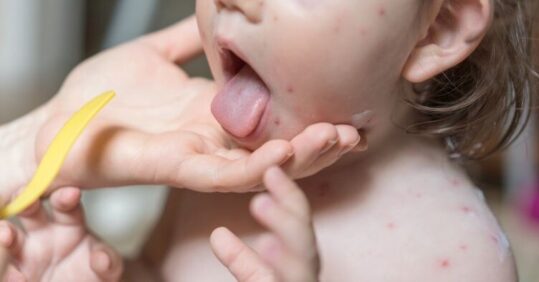
Children with chickenpox present with a non-specific prodrome of fever and fatigue, following which the typical vesicular rash starts to appear, spreading for 5-7 days before crusting over.
It is highly infectious – 90% of susceptible individuals will catch chickenpox after contact with an infected person – and can lead to significant complications (see Box 1), as well as costing the UK economy £24 million per year in lost parental time at work.
Related Article: No extra testing needed for notifying chickenpox cases, guidance says
Savvy parents prevent this by vaccinating privately (one survey of paediatricians found that 73% had done so for their own children), so why is it only now that we are considering NHS vaccination?
Box 1. Complications of chickenpox
These can occur in anyone, but are more common and serious in those who are immunocompromised.
- Secondary bacterial infection of the skin.
- Pneumonia
- Central nervous system consequences – encephalitis, Guillain-Barré syndrome, stroke.
- Hepatitis
- Optic neuritis.
- Myocarditis
- Foetal varicella syndrome if caught in the first 20 weeks of pregnancy.
- Neonatal varicella if caught in the last week of pregnancy.
Why hasn’t vaccination been introduced before?
The Joint Committee on Vaccination and Immunisation (JCVI) decided against universal varicella vaccination for children in 2009, but more recently changed their mind when considering it again in 2023. The original decision was based on concerns about a lack of cost-effectiveness, with an estimate that it could take up to a century for such a programme to become cost-effective.
The main worry was that that by vaccinating children, we would inadvertently increase the prevalence of shingles in older adults, with associated healthcare costs. (See Box 2 below for a reminder of the relationship between chickenpox and shingles.) The theory was that contact with children who have chickenpox (who will not be isolated at home during the infectious prodromal period) boosts immunity in adults, thus inhibiting varicella reactivation and reducing cases of shingles.
Box 2. The relationship between chickenpox and shingles
- After someone has recovered from chickenpox, the varicella virus doesn’t leave the body; it stays dormant in the dorsal root ganglia, a cluster of nerve cells near the spine.
- Years/decades later the virus can reactivate, causing shingles, a painful rash which is limited to one dermatome (the skin supplied by one spinal nerve).
- Shingles resolves spontaneously, but can also cause complications, the most common of which is post-herpetic neuralgia (PHN), a cause of chronic neuropathic pain which can be serious and difficult to treat. As many as 75% of those who get shingles over the age of 75 may develop PHN.
- Other complications of shingles include paralysis of the facial nerve, pneumonia, optic neuritis and hepatitis.
Why is chickenpox vaccination now deemed worthwhile?
So if chickenpox vaccination wasn’t cost-effective in 2009, what changed to make the JCVI deem it worth doing in 2023? The decision was largely based on two issues – a re-evaluation of the costs of chickenpox complications, and a change in thinking around the risk of adult shingles.
The JCVI believes that the costs of hospital admissions due to chickenpox are underestimated due to poor coding. Someone admitted with chickenpox complications might well have their admission coded as pneumonia, cellulitis or stroke, with the coding not recognising that varicella was the underlying cause of the admission. Quality of life reductions with chickenpox were also considered, and the cost-effectiveness was boosted by the fact that varicella vaccine is available in a single injection with the measles mumps and rubella vaccine (MMR), thus negating the need for an extra nurse appointment in the childhood vaccination schedule.
Turning to the risk of increased adult shingles due to childhood varicella vaccination, the landscape has changed significantly since 2009 with the advent of NHS vaccination against shingles. Data from the United States, where childhood varicella vaccination was introduced in 1995, has not shown an increase in adult shingles, and so this is now not thought to be a concern.
When will children start being given the vaccination?
So who is eligible for varicella vaccination now, how is it going to change, and when will the change happen? As of August 2025, eligibility is limited to susceptible healthcare staff (including laboratory staff who work with the varicella virus), susceptible household contacts of immunocompromised patients, and susceptible individuals who are due to start immunosuppressive treatment (provided there is time for them to have both doses before starting the treatment).
Related Article: CPD: Case by case – routine childhood vaccinations
NHS England have announced the ‘potential’ start of routine childhood varicella vaccination in quarter 2 of the 2025/26 year (ie, from January 2026). As of August 2025 this is still subject to ministerial approval, but under the proposal the universal childhood vaccine offer will see the new combined measles, mumps, rubella and varicella (MMRV) vaccine offered at 12 and 18 months of age.
(The second dose of the MMR vaccine is already being brought forward from 3 years 4 months to 18 months for all children who turn 18 months on or after January 2026 and the MMRV vaccine will replace MMR when the programme is finalised.)
Specifically, the proposal indicates:
- Children turning 12 months on or after 1 January 2026 will receive two doses of MMRV (at 12 and 18 months).
- Children turning 18 months on or after 1 January 2026 will receive one dose of MMRV (to complete their two-dose MMR schedule).
- Children aged 18 months to 3 years 4 months on 1 January 2026 will receive one dose of MMRV instead of their second MMR dose. Of this cohort:
– those aged 18 months to 2 years 6 months will be invited to a brought forward appointment for their second MMR dose (as MMRV) between 1 January 2026 and 31 October 2026;
– those aged 2 years 7 months to 3 years 4 months on 1 January 2026 will receive their 2nd MMR dose (as MMRV) at their existing scheduled 3 years 4 months appointment before 31 October 2026. - Children aged 3 years 4 months to less than 6 years will be invited for a universal single catch-up dose of MMRV. Appointments to be scheduled from 1 January 2026 and completed by 31 March 2027.
- Children aged 6 years to less than 11 years will be invited to receive a single dose of MMRV if they have no history of chicken pox. Appointments to be scheduled from 1 January 2026 and completed by 31 March 2027.
- From 1 April 2027, an opportunistic or on request offer will remain for varicella (as a single dose of MMRV) to all children aged 3 years 4 months to less than 11 years before 1 January 2026 who have no history of chicken pox.
Key points
- Contrary to popular belief, chickenpox is not mild and can be associated with serious complications in anyone, but especially those who are immunocompromised.
- Chickenpox is highly contagious and people with chickenpox are infectious before developing the typical vesicular rash.
- The JCVI has now recommended chickenpox vaccination be incorporated into the routine infant immunisation schedule because new evidence shows it is cost-effective, and won’t increase the risk of shingles in older people.
- The planned new vaccine is incorporated into a combined vaccine with MMR so it won’t mean an extra nurse visit for children to be vaccinated.
Dr Toni Hazell is a portfolio GP in north London
Related Article: ‘Potential’ introduction of chickenpox vaccine in early 2026

See how our symptom tool can help you make better sense of patient presentations
Click here to search a symptom