CNO ‘terrified’ about falling vaccination rates and rising hesitancy
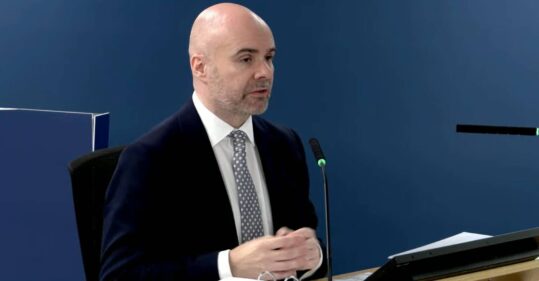


The chief nursing officer (CNO) for England has said he is ‘terrified’ about falling vaccination rates among children and young people and ‘deeply concerned’ about vaccine hesitancy across the UK.
Speaking at the Covid Inquiry on Wednesday, Duncan Burton described how the importance of future pandemic preparedness.
‘One of the things that has come out of the pandemic is that we will see resurgences of other viruses and conditions, so being prepared for future is really important,’ he told the inquiry.
‘And this is why keeping vaccination rates high is something that’s really important across the board for all conditions going into a pandemic.’
He added: ‘I’m deeply concerned and in some ways terrified by the some of the vaccine rates within children and young people.’
Related Article: Flu and Covid levels ‘starting to slowly increase’
Recent data has shown falling vaccination rates among children and young people, with figures published by the UK Health Security Agency (UKHSA) last month showing that a fifth of children in England who turned five in the 12 months to April 2024 did not receive the pre-school booster vaccine.
This means 18.6% of children turning five between 1 April 2024 and 31 March 2025 were not given the jab which helps protect against polio, whooping cough, tetanus and diphtheria.
Rising measles cases
Mr Burton expressed his concern about rising measles rates across England which he also linked with vaccine hesitancy.
‘If you look at the cases of measles in this country, we have too many cases of measles, so I’m deeply concerned that we have vaccine hesitancy going on now,’ he said.
Data published at the end of last month by the UKHSA showed that measles figures were slowing in England, but this came with a warning that vaccine uptake was still below the level needed for herd immunity.
Last year there were 2,911 laboratory confirmed measles cases in England – the highest number of cases recorded annually, since 2012.
A national incident was called after a large outbreak in the West Midlands in January 2024.
A unique identifier number
Responding to questions from Jacqueline Carey KC, Mr Burton was also asked whether the government’s commitment, announced in the 10 year health plan, to introduce a ‘unique identifier number’ that would be used to identify children across health, social care and education settings was a ‘realistic’ goal.
Related Article: Menstrual changes associated with long Covid symptoms
‘I don’t think it’s a question of realism. You can’t put a child in a health box, in an education box, in a social care box – safeguarding crosses over all of those.
‘So, I think this is not a question of whether we should do it. We have to do this and find a way to do it,’ he said.
The CNO suggested a ‘unique identifier number’ could be an individual’s NHS number, which everyone registered to the NHS in England has.
‘Health services will also do more to play their part in child safeguarding. We will work in partnership with the Department for Education to implement a single unique identifier for every child, to enable proactive, preventative and joined-up care across different public services,’ the plan states.
The NHS winter flu vaccination programme began last month, with pregnant women and children having been eligible for the vaccination from September 1.
Related Article: Nurse had to ‘freeze’ PPE during pandemic to re-use in care home, Covid inquiry hears
Since the start of October, other eligible adults have also been vaccinated across GP practices, including adults aged 65 and over and eligible frontline workers in a social care setting.
The respiratory syncytial virus (RSV) vaccine has been available to pregnant women and older adults aged 75 to 79 years old in England, Wales and Northern Ireland since last September and in Scotland since last August.
Previous CNOs have also shared their concerns about the future of public health in their appearances at the Covid Inquiry, with former CNO for England, Dame Ruth May, last summer describing the removal of the bursary for student nurses as a ‘catastrophic decision’.

See how our symptom tool can help you make better sense of patient presentations
Click here to search a symptom