‘Scope and desire’ for pharmacy and practice nurse collaboration but funding a barrier


There is a ‘real scope and desire’ for practice nurses and community pharmacies to work more closely together but funding issues remain a significant ‘barrier’, a Royal College of Nursing (RCN) leader has said.
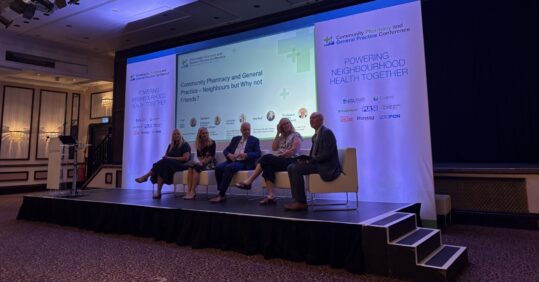
Speaking at the new Community Pharmacy and General Practice Conference, hosted by Nursing in Practice’s publisher Cogora, RCN primary care nursing lead Kim Ball stressed it was important that nurses and primary care colleagues do not work in isolation and that there were opportunities to work more closely across the system.
Ms Ball, who featured in an opening plenary on the second day of the conference in Birmingham, argued that while the business models of GP practices and pharmacies are pitted against one another, there was a need to better integrate in the interest of patient care.
‘Whilst we do have business models that are very much in competition with one another, this is not about role substitution, this is about working to each other’s key strengths and ensuring that we’re delivering for the patient, and that’s got to be at the heart of it,’ she said.
Ms Ball reflected on a recent example of joint working, in which, as an immunisation trainer and educator, she supported a local pharmacy with a training package for vaccinating young children – a new offer pharmacies can now bring.
Related Article: Health services urged to ‘be prepared’ as red heat-health alert issued
‘I’m an immunisation trainer, an educator, and an experienced vaccinator, and they had some apprehensions,’ she explained.
‘They’ve been vaccinating adults for many, many years, and children were a new concept for them. So we worked together.’
In delivering a small training package, they visited a preschool to deliver some vaccinations together.
‘Although this was done outside of my general practice role, it was done on a voluntary basis, it really helped community pharmacy benefit from being able to do some outreach work,’ explained Ms Ball.
‘They benefited from being able to upskill and develop their skills in immunisation, and those key opportunities are really, really important.’
But she stressed that these opportunities would only happen ‘if the funding is available to help that flow’.
Speaking to Nursing in Practice at the conference, Ms Ball noted how some pharmacies are employing practice nurses and how GP practices are employing pharmacists.
‘So, there is a real scope and a desire to want to work closely together, and we are becoming much more integrated as a team, but there is still work to do, and I feel that the funding is likely to be one of the largest barriers to that,’ she said.
She added: ‘Funding [is needed] for nurses and for pharmacists. Their time is so precious, and lost clinical time is lost funding and access for patients. With greater funding opportunities where things like backfill can be used to cover those clinical responsibilities, will free people up to have that innovation and that time to be able to spend time working together.’
Related Article: Needle-free adrenaline treatment approved for young children
Alongside funding, Ms Ball argued that practice nurses and pharmacists needed a better direct line of communication to better work together, and that there were also potential placement opportunities for nursing students to experience a pharmacy setting.
‘I think it’s really important that we break down those communication barriers,’ Ms Ball told Nursing in Practice.
‘So, for a pharmacist to phone general practice, and maybe be on hold for a significant amount of time, that clinician may be in practice, it may be difficult for them to speak with each other, so we really need direct lines of communication where we can bypass the usual routes and have that direct conversation when we need it, for the need of patients, to be able to escalate.’
She added that the ‘biggest opportunity can come from our undergrad workforce, and thinking about student placements’.
‘How they can have the opportunity to have cross working placement opportunities where they can build those relationships,’ said Ms Ball.
Ultimately, she argued that by not working in isolation and by improving opportunities to work together more closely, GP practices and pharmacies can help strengthen patient care.
Related Article: Nursing staff ‘relying on credit cards for basic living costs’, warns union
When asked about the importance of the nursing voice at today’s conference – which is focused on bringing together colleagues across primary care for improved integration and collaboration – Ms Ball said: ‘The term general practice, which often gets shortened to GPs, can make nurses feel excluded from those conversations.
‘So, I really welcome the opportunity to come today and meet some people, and hopefully for some conversations off the back of that.’
The opening plenary session – Community Pharmacy and General Practice – Neighbours but Why not Friends? – also heard from Professor Victoria Tzortziou Brown, president of the Royal College of GPs council; Catriona Sinclair chair of the Scottish Pharmacy Advisory Council and vice president of the Royal College of Pharmacy; Professor James Kingsland, GP, development lead, NHS North West Neighbourhood Health Programme and chair of the Digital Clinical Excellence Forum (DiCE) UK. It was chaired by David Webb, chief pharmaceutical officer for England.

See how our symptom tool can help you make better sense of patient presentations
Click here to search a symptom