‘I must warn you that this blog won’t be an easy read’
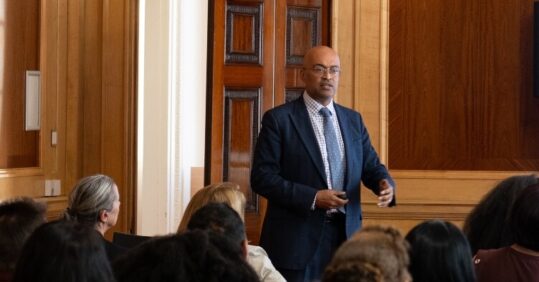


‘Have you ever wondered where your personal values come from? I can trace the development of mine back to my childhood’, says the Nursing and Midwifery Council’s chief executive Paul Rees.
I must warn you that this blog won’t be an easy read, but – as the new chief executive and registrar of the NMC – I think it’s important for me to share.
We are currently building a new NMC. One that can be the strong and independent regulator of nursing and midwifery professionals that everyone wants. One that is a fair regulator, with a strong sense of equity.
Living out our values in all the decisions we make will be crucial to our work.
So, where do my values come from?
When I was at primary school, in the London suburb of Mill Hill, I was one of only a handful of Black, Asian and ethnic minority kids there.
In the playground, the older white kids regularly called me the N-word and told me to ‘go back to the jungle’. The Asian kids were routinely called the P-word.
On my way to and from school, older white boys, from the local secondary school, would push me, spit at me, and say I should ‘go back home’.
Having been bullied, due to my skin colour, from the age of six, I’ve also always had an intense dislike of bullying and discrimination
Once when I went to Thorpe Park, as part of a primary school trip, a young man, in his early 20s, pushed me to the ground and shouted racist abuse in my face.
At secondary school, the racism was worse, and I was often chased by older white boys, who boasted about carrying knives, and wanted to beat me up.
As I grew bigger and taller, and went through the years, I started standing up to the racists.
A friend of mine, who was Black, and I, gradually prevented the racists from beating up any more Black or Asian kids.
On one occasion, I ran into the road, near school, and stood between a group of older racists and an Asian boy they were about to beat up.
Because I stood up to the racists, one day, a white skinhead, who had been expelled, came back into school, high on drugs, to try to stab me. But I managed to run away from him, and hide in the school library.
Some of the teachers were racist too.
Sometimes in class I would talk to my best friend, who was white, when I should have been working. One teacher in particular would shout, in a mock African accent: “Paul Rees: don’t talk to clever white man!”
On one particular occasion, the same teacher walked into our classroom, five minutes into lesson time, and shouted: “Paul Rees: g*lliw*gs! Paul Rees: g*lliw*gs!”
This was meant to be a ‘humorous’ way of introducing the topic of jam production in the UK, as part of a geography lesson – as one British jam company, Robertson’s, always had an illustration of a ‘g*lly’ on the side of their jam jars.
Many of my teachers believed that Black people were mentally inferior, and I was often told the ‘best’ I could hope for when I grew up was to be a bus driver.
Much of my career since then has been driven by a desire to prove those people wrong – and, as a result, I was delighted when, as chief executive of the Royal College of Psychiatrists, I was awarded with an MBE for services to mental health and equality, diversity and inclusion.
The fact I was the first ever Black chief executive of a medical royal college, as well as being – as far as I know – the first Black chief executive of a national community pharmacy body and now the first Black chief executive of a regulator for healthcare workers fills me with immense pride.
The racist kids and teachers of my past would have been shocked by what I’ve gone on to achieve.
During my school years, the person I used to talk to, to seek mental health support, was my grandfather on my mother’s side.
He was an elderly white man, who had been born into poverty, but had gone on to be the chair of the Socialist Party of Great Britain and a trade union activist.
He had a strong sense of social justice and would tell me that, in our society, various groups of people – such as people of colour and Jewish people – are marginalised and blamed for society’s ills. (Our neighbours and friends, Mr and Mrs Sontag, were Jewish immigrants who had come to the UK, to escape the Holocaust.)
My grandfather would also tell me that marginalised people – and other working people – are often poorly treated in the workplace.
To create a just workplace we need to make sure that everyone is treated with respect, regardless of their background and characteristics
As a result, I’ve always had a passionate belief that to create a just society we must tackle racism, sexism, homophobia, antisemitism, Anti-Muslim hate and all other forms of discrimination.
And that to create a just workplace we need to make sure that everyone is treated with respect, regardless of their background and characteristics.
Having been bullied, due to my skin colour, from the age of six, I’ve also always had an intense dislike of bullying and discrimination.
That means the central pillars of the NMC Culture Transformation Plan – embedding EDI, ensuring psychological safety and promoting enjoying work – align with my personal principles, as do our new NMC values of Integrity, Fairness, Respect, Equity and Effectiveness.
A strong and independent regulator that prioritises these principles and values will strive to ensure that the Fitness to Practise process is as fast and fair as possible, with disparities of treatment based on ethnicity and gender eliminated.
It will also work to ensure that the promotion of excellent and inclusive education and standards for nursing and midwifery students and professionals is a top priority.
At a time of heightened tensions across our society this is the kind of regulator we need – one that ensures that all nursing and midwifery professionals are treated with respect, through our regulatory processes, regardless of their background or characteristics.

See how our symptom tool can help you make better sense of patient presentations
Click here to search a symptom