‘General practice nurses must be seen as the leaders they are’
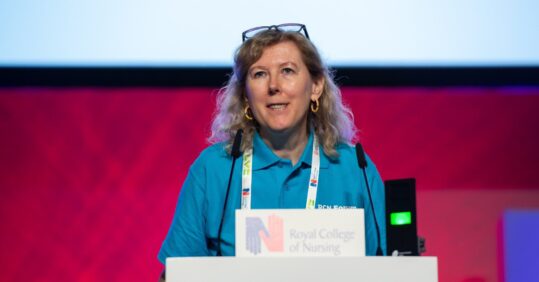


Former chair of the Royal College of Nursing General Practice Nursing Forum and a nurse of over 30 years, Ellen Nicholson, reflects on the difference made by nurses working across general practice, the lack of recognition for the profession and the need for nurses to be represented in national negotiations on the GP contract. This article comes as part of Nursing in Practice’s How Nurses Count campaign, which aims to champion nursing expertise and innovation.
General practice nurses (GPNs) have an integral role in the government’s shift away from hospital care and towards community settings and prevention, but there continues to be a ‘lack of recognition’ of the skills, qualifications and role of the profession, says Ms Nicholson.
‘I just feel like we’re stuck in this time of thinking of a nurse when they wore dress uniforms and ward hats, and we haven’t been able to move on,’ she adds.
‘And yet the profession is so integral to population health management within primary healthcare.’
Around 20% of appointments in general practice are carried out by a nurse – and in October 2025 this translated to 8.5 million appointments.
Yet Ms Nicholson says the role of GPNs is not properly recognised by the government and that often, practice nurses are not valued as the leaders that they are.
Crucially, GPNs are ‘influencing wider social determinants of health’ as well as patients’ actual health, and pride themselves in taking a holistic approach, she says.
Related Article: ‘Nursing is not just a career, it has a world of possibilities’
Ms Nicholson gives of an example of when she supported a patient with smoking cessation. Her clinical expertise and intervention led to her referring the patient for a chest X-ray, which later identified lung cancer, she explains.
‘We’d been going through the motions of doing a particular intervention, but actually we needed to look outside that box,’ she says.
‘I think that’s where we make so much difference, because we’re actually looking at people holistically, rather than just at a condition.’
She says there are also instances where GPNs see patients for cervical screening or period disorders and while using a speculum identify other issues that have not been picked up by other clinicians.
‘Nurses are also influencing wider social determinants of health, as much as an individual’s actual health,’ Ms Nicholson points out.
She gives examples of asking patients with a leg ulcer about their housing conditions or giving advice to patients with diabetes on food choices.
‘I think it’s the perception of nurses and how they’re perceived by the system,’ she says.
‘It’s a system wide issue [around] their relevance, because they’re not necessarily the people who are running the practices, although we have nurse partners and a nurse-led GP surgery. It’s that perception of where they sit within the hierarchy.’
GPNs are not seen as ‘people who are leading the system, which is false, when you consider there are people out there who are absolutely pioneering and leading the system as nurses’.
A key issue is that nurses are not represented in negotiations on the GP contract, says Ms Nicholson, despite a long running campaign from the Royal College of Nursing (RCN) to be involved.
Related Article: More than half of GPNs report working while feeling mentally unwell, finds survey
Last year the government announced that the British Medical Association (BMA) would no longer be the sole negotiator of GP contract terms for the next financial year, and that other organisations, including the Institute of General Practice Management (IGPM) and Royal College of General Practitioners (RCGP), had been given a place at the table.
The RCN has since written letter to primary care minister Stephen Kinnock about the need to give the college a seat on negotiations for the 2026/27 but there is no further update as yet.
When asked if she felt the government was listening to the needs of GPNs, Ms Nicholson said: ‘I think there’s still more to be done. I think a little bit has changed. I think the fact that the contract negotiations have been opened up a little bit wider is a sign of change.
‘However, it hasn’t been opened up to the RCN, so there’s clearly a lack of recognition of the role that nurses play within general practice.’
She adds: ‘How can you not let the RCN be involved in those negotiations when you know that [around] nine million of those appointments that happen on a regular monthly basis, or approximately that, are from nurses? Why would you not let them be involved?’
Ms Nicholson says it feels like ‘there’s a glass ceiling, and you’re kind of a muffled voice shouting through it’.
If given an opportunity to sit down with the government, Ms Nicholson says she would deliver a message that: ‘The 10-year plan, the shift to primary care, and from healthcare to prevention is essential, and nurses within primary care are essential to that.
Related Article: Practice nurses call for Agenda for Change terms and conditions to ‘feel safer’
‘It’s not GPNs, it’s community nursing as well. Any government agenda will not happen without these key people.’
Our How Nurses Count campaign aims not only to encourage nurses across primary and community care to share best practice and learn from one another, but also to ensure that their collective voice is recognised at the highest levels.
How Nurses Count seeks to amplify the experiences and insights of nurses so they are heard by employers, policymakers and government, making clear the essential role primary care nursing plays in shaping effective, equitable healthcare.
Please get in touch with news and features writer Madeleine Anderson ([email protected]) or acting editor Megan Ford ([email protected]), to be involved in our campaign and share how you count.

See how our symptom tool can help you make better sense of patient presentations
Click here to search a symptom