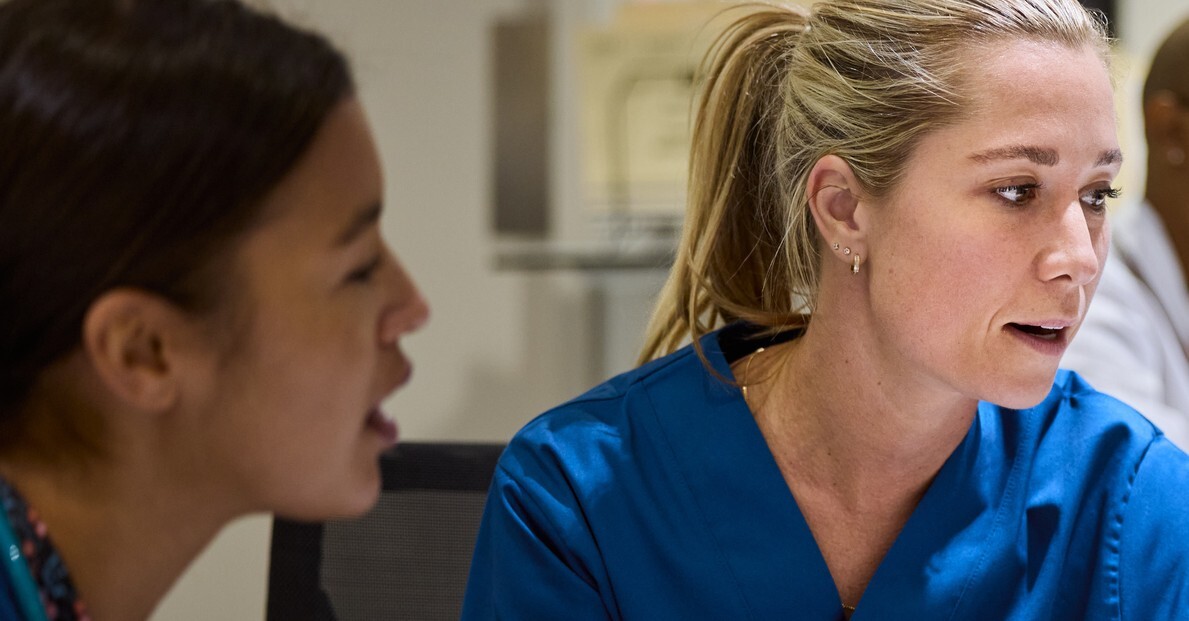
‘GPNs support people through the most vulnerable, meaningful moments of their lives’



Lead practice nurse, Natalie Holdaway, wants to advocate for more student nurses to learn about general practice. She highlights the continuity of care general practice nurses (GPNs) take on and the ‘continuous development’ offered in the position. This article comes as part of Nursing in Practice’s How Nurses Count campaign, which aims to champion nursing expertise and innovation.
‘General practice has that continuous development… it’s a fantastic role to step into,’ says Ms Holdaway, who started her career as a healthcare assistant in primary care before later becoming a lead nurse at her clinic in Hampshire.
‘It’s about supporting others to be able to come into that environment, lifting colleagues up, and just letting people know that general practice is, for me, the heart of nursing,’ she adds.
Ms Holdaway says she wants to use Nursing in Practice’s How Nurses Count campaign to advocate for ‘real investment’ in structured training pathways and for ‘greater awareness of the incredible career opportunities within primary care’.
She adds that ‘national recognition of the vital impact GPNs have on patient outcomes and the wider NHS’ is also essential.
‘But more than anything, I would advocate for the support that truly shapes a nurse, because without the support I’ve had along my own journey, I simply wouldn’t be where I am today.’
Ms Holdaway always knew she wanted to be a nurse and went to college to complete her General National Vocational Qualifications (GNVQs).
She says: ‘But then life got in the way, and I ended up not progressing. I met my husband, started a family, and I still really want to be in the healthcare industry.
‘I joined a GP practice as receptionist and I went through all the admin roles and built myself up through that and then became a healthcare assistant.
Related Article: ‘Nursing is not just a career, it has a world of possibilities’
‘I was doing a lot of wound care and I was spending some a lot time with the nurses. And I remember one of the nurses said to me, “If you don’t ever do it, you never will”.’
The mother-of-four went back to college to finish her maths GCSE and completed an academy online learning access course from home.
‘They were the things that I needed to get into university and the rest just feels like history,’ she adds.
During her studies, Ms Holdaway said she was ‘sad’ to find that general practice was not one of her work placements.
She hopes to advocate for general practice placements being offered to all students and is aiming to push for it at her own clinic next year.
‘I would advocate for general practice placements being an essential part of being a student nurse,’ she says. ‘If students had one placement in general practice it would open it [up] so that everybody can see how much it offers and how much you can progress.
‘It’s something I’m really pushing for at work. Next year I’m pushing for nursing students as we need to future proof.
‘My nurse colleagues are retiring… and where are we going to be left without general practice nurses? It’s quite frightening.’
Though Ms Holdaway did not complete a general practice placement, her experience in secondary care and community care inspired her to become a GPN.
While in secondary care she treated a patient for 12 weeks in hospital before he was discharged home. Then she treated the same patient while working as a community nurse.
‘We actually went to his home, which was really bizarre, and he remembered me completely,’ she says.
‘He made me a cup of tea and seeing that progress of a patient who could barely get out of bed to now being in his own home environment… it was that continuity of care.
‘With every other patient, they go home and you don’t know what happens. With general practice you’ve got your regular patients, and you build up that rapport with them.
‘We support people through some of the most vulnerable, meaningful moments of their lives.
‘It’s that clinical expertise with the human connection as well. It’s having that connection with people, supporting people, [and] that continuity of care absolutely stands out for me.’
Ms Holdaway then qualified as a nurse in 2019 and emailed several GP practices after setting her heart on primary care.
Related Article: More than half of GPNs report working while feeling mentally unwell, finds survey
After being told by other practices that she did not have enough experience, she landed a role at a practice in Hampshire.
She then went on to complete the Foundations in General Practice Nursing course with Health Education England (HEE) funding.
‘I was very lucky because I was able to do the HEE-funded Care of Minor Illness at Bournemouth University and gain my PgCert in Primary Care Master’s Level 7 with a Distinction.’
She recalls being given ‘structured supervision’ and protected learning time, as well as peer support, which she says allowed her to become ‘confident and autonomous’ in her role.
Ms Holdaway is now training to be a prescriber after six years of practice nursing and has become the lead nurse at her clinic.
She hopes to encourage more nursing students to learn about general practice nursing, highlighting the wide range of skills needed for the role, from immunisations and vaccines to dealing with long term conditions such as diabetes and menopause.
‘Could you imagine not having GPNs,’ she says. ‘Everything comes through to us, everything is general practice led.
‘We see a wide range of complexities within care, and you’re looking at a patient holistically. So, I feel that without general practice, it’d be quite scary.’
She adds: ‘Nurses are, and healthcare assistants as well, are the backbone of the healthcare system.
‘There’s so much that goes on quietly that nobody really notices… I’ve had medical students come in with me and they say, “Oh my gosh, we didn’t realise how much you do”.
‘General practice nursing feels like home to me. It’s the heart of nursing. It’s where I found my confidence, my identity, and my purpose.
Related Article: Practice nurses call for Agenda for Change terms and conditions to ‘feel safer’
‘If sharing my story gives even one person who doubts themselves the nudge they need to take that first step toward becoming a nurse, or to believe they can grow within primary care, then that, to me, is an achievement in itself.
‘Inspiring someone else, just as others inspired me, is exactly why I will always speak up for GPNs and for the future of primary care.
‘I am incredibly proud to be a GPN, and to be part of a profession that represents the very best of compassionate, patient centred nursing.’
Nursing in Practice’s How Nurses Count campaign aims not only to encourage nurses across primary and community care to share best practice and learn from one another, but also to ensure that their collective voice is recognised at the highest levels.
Please get in touch with editor Megan Ford ([email protected]) or senior reporter Gee Harland ([email protected]), to be involved in our campaign and share how you count.

See how our symptom tool can help you make better sense of patient presentations
Click here to search a symptom