RCN chief on ensuring ‘we get things better’ for general practice nurses
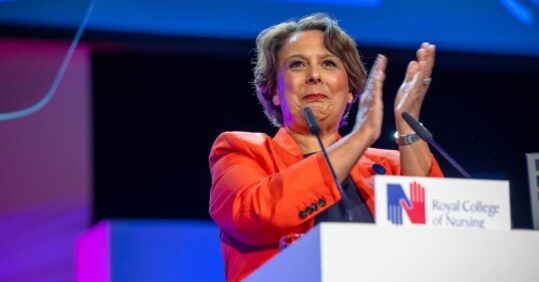


Royal College of Nursing (RCN) chief executive and general secretary Professor Nicola Ranger sits down with Nursing in Practice editor Megan Ford to discuss the most pressing issues facing nurses in general practice. They catch up at this year’s RCN Congress in Liverpool, where concerns around pay, terms and conditions, unpaid hours, workforce pressures and more have been debated and discussed by the profession.
In an interview with Nursing in Practice, Professor Ranger was quick to assure that the RCN has ‘woken up’ over the past few years and realised that ‘we need to do more for general practice nursing’.
She says RCN director for England Patricia Marquis is ‘particularly focused on ensuring that we get things better for general practice nurses’.
‘We’re worried about pay progression’
Among the most pressing issues the RCN wants to address for nurses working in general practice include pay, terms and conditions.
‘We’re worried about pay progression for general practice nurses [and] we’re also concerned about the terms and conditions,’ says Professor Ranger.
‘It is very difficult to get people to want to work in general practices sometimes because of the terms and conditions.’
Her comments come soon after the publication of Nursing in Practice’s latest general practice nurse (GPN) pay report – which revealed nurses working in general practice are earning thousands of pounds less than their hospital colleagues, and that more than a third of GPNs went without a pay rise for 2025/26.
Professor Ranger suggests the RCN has been ‘very clear’ with the government and with GPs that any pay rise needs to be passed on to their practice nurses. However, she recognises that, ultimately, it is down to GP partners to make that move.
Related Article: How a nurse-led community mental health hub is improving patient care and access
‘It’s got to be a different system’
In line with ongoing recommendations of the RCN – that were echoed in our recent report – Professor Ranger reiterates the need for a ‘ringfenced’ funding stream for general practice nursing staff.
‘We understand that GPs run their own businesses, we understand that, but we think it should be absolutely clear from the government that that money is ringfenced for their nursing staff,’ she tells Nursing in Practice.
‘You would want to be able to trust each practice, each employer, to be able to give that to the nurses, but hearing so many that aren’t getting their money – it’s just not OK.
‘It’s got to be a different system, because what you can’t rely on is goodwill and people doing the right thing, because they’re just not.’
Another ongoing call of the RCN is to be included in national negotiations on the GP contract, to ensure the nursing voice is heard when decisions around general practice funding are made. These calls have particularly ramped up since the British Medical Association (BMA) lost its space as the sole negotiator last year, and organisations such as the Institute of General Practice Managers and the Royal College of GPs made the cut.
‘We’re being kept out of negotiations’
‘I think at the moment we’re being kept out a little bit, but it’s something that I absolutely do want to see,’ she says about being involved in national talks on the GP contract.
‘I want to see it change. I think they know that we’re there to fight for the general practice nurses, and I think they’re a little bit reticent for our voice at the table, but I think we’ve got to be unapologetically there as the RCN, where our sole purpose is for the wellbeing of those nurses in those practices.’
The RCN has been highlighting in recent weeks the promise by the government to review all Agenda for Change Band 5 nurse roles. This week, RCN president Bejoy Sebastian suggested that unless the government delivered on its promises, he would be prepared to return to the picket lines and take strike action.
Speaking at our Nursing in Practice London event last month, Professor Ranger recognised that many GPNs would be excluded from the review because they are not on Agenda for Change. In fact, our recent survey showed as little as 11% of nurses working in general practice are on such contracts.
However, the RCN chief executive said she wanted to see the outcomes of the review mirrored across the whole of nursing, including in general practice.
When asked what the RCN was doing to ensure nurses in general practice are paid in line with their qualifications in her interview with Nursing in Practice this month, she reiterated the same message about the role review.
‘I think it’s going to be difficult. The only thing that we’ve got that’s fully aligned or fully committed to is the agreement from the government around Agenda for Change. We haven’t got that for everyone else, but we know that it absolutely influences – so I hope that over time that will start to get better,’ she says.
‘GPs must stand shoulder to shoulder with ANPs’
Also among her top issues for general practice nursing is the ongoing concerns and claims being made around advanced nurse practitioners (ANPs). This was a key feature in her address to RCN Congress earlier this week, in which she encouraged advanced nurses to ‘wear their title with pride’.
The situation stems from comments made by the BMA and its members around doctors being ‘substituted’ with ANPs and other advanced practitioners. A member survey suggested many doctors feel the use of ANPs poses a risk to patient safety. Professor Ranger said this week she was ‘angry’ at the BMA for dragging down the nursing profession while trying to elevate its own.
Related Article: ‘Nursing is not just a career, it has a world of possibilities’
Speaking to Nursing in Practice, she reiterates her disappointment and says she hopes GPs stand in support of their ANP and specialist nurse colleagues.
‘GPs will know that they are specialist nurses and their advanced practice skills, and I think it’s disappointing that the BMA have questioned nursing skill,’ says Professor Ranger.
‘I think it’s important for the GPs to stand shoulder to shoulder with their advanced practitioners and their specialist nurses.
‘There’s something about that professional interaction that needs to be strong with regard to ensuring that nurses don’t step away from that.’
ANPs must not be treated as an optional extension
A debate at this year’s RCN Congress saw nurses vote to ensure the college acts upon attempts to ‘undermine’ advanced nursing practice – warning that without these vital roles, GP practices and accident and emergency departments ‘would drown’.
Practice nurse Hannah Pollock, of the RCN’s GPN Forum, was unable to add her thoughts during the debate due to time constraints but submitted what she would like to have said to Nursing in Practice.
‘In general practice, nurses are running independent clinics across multiple specialities, many of which would have sat firmly within the remit of GPs 10 or 20 years ago.
‘These nurses are not simply “supporting” care – they are delivering it autonomously. They are specialist trained, highly skilled, making independent diagnostic and treatment decisions, managing long-term conditions, and in many cases independently prescribing.
‘And they are doing this safely, effectively, and to an exceptionally high standard.’
Related Article: More than half of GPNs report working while feeling mentally unwell, finds survey
She said that when advanced nursing practice comes under questioning, ‘what is really being questioned is the expertise, judgement, and leadership of an entire workforce that modern healthcare depends upon’.
‘If we truly value patient access, preventative care, and sustainable primary care services, then we must stop treating advanced nursing practice as an optional extension of nursing and start recognising it as the highly skilled clinical leadership role that it already is,’ she added.
Other debates at RCN Congress last week included a focus on tackling misinformation, protecting nursing education, and creating a programme to help build the confidence of nursing staff in addressing racism.
Other discussions centred on the ‘normalisation’ of unpaid hours in general practice nursing, and calls from district and community nurses for urgent national standards for lone working after they encountered patients with weapons.

See how our symptom tool can help you make better sense of patient presentations
Click here to search a symptom