
The life-saving work of LD nurses in general practice


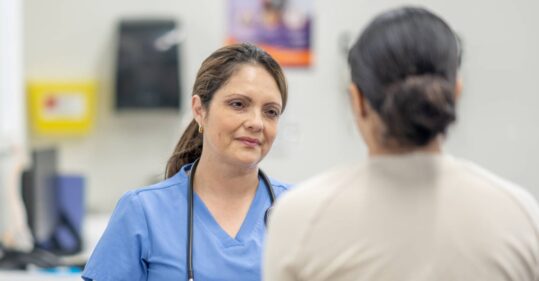
Madeleine Anderson asks why, in a system striving for preventative, community-based care, registered learning disability nurses (RNLDs) are still so rare in general practice. She looks at how some GP practices have introduced the RNLD role into their services and asks what difference this has made to the patients receiving care and the nurses giving it.
The situation has been made more pressing by a letter that was sent this month by the health and social care secretary and Mencap to all GP practices in England, asking practice staff to ensure eligible patients are added to learning disability registers. Our analysis also comes as RNLD numbers are struggling across all settings, with Nursing in Practice exclusively reporting in June that NHS England (NHSE) projects England’s domestic supply to end by 2028.
‘They’ve never told me that before’
For many RNLD’s in general practice, annual health checks are core to the care they offer.
However, only just over a quarter (26%) of people with a learning disability are on the learning disability register, according to research by The Nuffield Trust.
This means that only 20% of people with a learning disability are receiving annual health checks.
Lisa Harrington is a RNLD who works as a primary care liaison learning disability nurse in several practices across West Kent Primary Care Network (PCN).
She describes how patients often disclose information to RNLDs that they haven’t shared with anyone else.
‘For some people with a learning disability, they may not offer information unless they are asked specific questions in a way that they understand,’ Ms Harrington explains.
‘I often hear “they have never told me that before” from carers who support patients with a learning disability They [patients] may not understand the importance of communicating the symptoms, or they may not know how to.’
In this context, time, and the opportunity for a review, isn’t a luxury, it’s a necessity – especially when caring for patients with more complex care needs.
‘The way I see it is that the annual health check is the beginning of meeting people’s health needs, so that you’re preventing their health from deteriorating and becoming more complex and chronic,’ Ms Harrington says.
The checks can take an hour or more and regularly require specialist soft skills and adapted communication, alongside clinical expertise.
Reflecting on the impact of her role to Nursing in Practice, Ms Harrington recalled caring for a patient who was suffering before her intervention.
The patient had a mild learning disability, lived alone with chronic obstructive pulmonary disease (COPD), and had been referred for urgent cancer screening. Despite early engagement with the practice, the patient stopped answering phone calls or replying to letters after his initial GP appointment and did not attend his hospital cancer screening.
After looking into why, Ms Harrington discovered that the patient was struggling to read and had not understood the letters or texts he had received from the hospital. He also did not answer the phone to unknown telephone numbers and was therefore not responding to any calls from the GP surgery or the hospital.
‘He had high anxiety following the GP appointment when he was referred as he heard the word cancer and was frightened.
‘He did not know what the investigations would entail and was struggling to leave the house due to breathlessness and was sleeping for a lot of the day,’ she told Nursing in Practice.
After a series of carefully tailored adjustments including clearer easy-read letters, closer liaison with hospital LD staff, and a referral to the community LD team, the patient finally received the care he needed.
‘The outcome from this has been very positive and with the support and reasonable adjustments in place he has been able to access all necessary hospital appointments and investigations,’ Ms Harrington said.
This story is testament to the difference that RNLD’s working in general practice can make, despite the rarity of their role.
In the interviews conducted for this feature, Nursing in Practice heard time and again the life-saving work that RNLD’s are delivering in practice, providing often unrecognised care and expertise for patients that are often overlooked.
What is a learning disability annual health check?
Annual health checks for people with learning disabilities were introduced in England in 2008, following a 2006 recommendation by the Disability Rights Commission to address health inequalities.
The check, which first focused on adults with a learning disability, was later expanded to include young people aged 14 and over in England from 2014.
It involves a physical examination, health tests such as a urine sample and lifestyle discussions with patients.
Related Article: What we know about the NMC registration fee increase so far
The check also includes a medication and vaccination review, to ensure medication and vaccine records are accurate and up to date, as well as a mental health assessment of the patient. Some checks also include a vision and hearing assessment.
Source: NHS England
Ms Harrington’s work to reach patients mirrors the efforts of Laura Aldalou, the lived experience co-chair of the All-Age Autism Strategy in Stockport, who previously worked as an RNLD across 32 GP practices in Greater Manchester. There, Ms Aldalou discovered patients who had not received a blood test in decades, including a man with diabetes who had gone blind in one eye and developed severe ulcers having not had a blood test in 26 years.
‘These are all things that wouldn’t have been picked up if those patients hadn’t attended their annual health check.
‘And those are all life-threatening conditions,’ she says.
The need for good data
Emma Gooding, who has worked in learning disability nursing for 25 years, is programme leader for learning disability nursing at The University of Northampton.
She believes that good care needs detailed and up-to-date data to be effective.
In a previous role, Ms Gooding worked as a strategic health facilitator across several practices around Northampton. This focused on reviewing records, coding LD patients, and flagging those most at risk.
‘With all that data,’ Ms Gooding explains, ‘you could run searches to say how many people do we have on our register with profound learning disabilities that also have a code of epilepsy? Then you could start to think about what are their health needs; what could we maybe do proactively to meet their needs?’
Opportunities for collaboration
Ms Gooding now conducts annual health checks in a shift role at a local GP practice.
She questions whether the model of one LD nurse per practice is the most effective approach, in terms of workforce planning.
She says: ‘One of the challenges about having RNLDs based within practice is about knowing what else they could be used for. Beyond the annual health checks, what would practices employ an LD nurse permanently for?’.
Despite this caution, Ms Gooding believes there’s scope for deeper integration of RNLDs in primary care, including supporting family liaison work and running joint clinics with social prescribers and general practice nurses (GPNs).
‘That would be an amazing joint piece of work in primary care,’ she said.
Is there a need for a ‘combined role’?
George Haley is an RNLD at Better Health MCR in Manchester. She previously worked on a year-long project funded to improve the uptake of cancer screenings and immunisations for people with learning disabilities across local practices.
Despite her best efforts, Ms Haley says she still saw high rates of DNAs (did not attends), which left her unsure of how else to use her time and question how best to use the RNLD role in general practice.
‘I think we need more of a combined role. Maybe someone who’s part general practice nurse and part LD specialist – or someone who focuses on managing care home patients more directly,’ she suggests.
Ms Haley shares Ms Gooding’s focus on the benefits of having reliable data, and says she has seen first-hand how many patients are mistakenly coded as having moderate or severe learning disabilities, when their condition is actually milder.
Ms Haley explains that she had prioritised face-to-face appointments, where contact had previously been limited to phone-based calls.
‘I gave demonstrations of the equipment and explained what the checks would entail. People appreciated being given that extra information.
‘It’s not always about lacking capacity, sometimes it’s just about clarity.
‘That time meant I could build trust, identify other concerns, and follow up properly, whether that was chasing referrals or connecting people with the right support,’ Ms Haley explains.
A proven impact
While there is limited national level data to support how RNLDs in general practice can improve health check uptake and appointment attendance, data shared exclusively with Nursing in Practice speaks to the major impact that RNLDs have on a local, practice level.
At West Kent PCN, annual LD health check completion rates stood at 58% in 2022-23, the year before Lisa Harrington took up her post. In her first year in the role, the uptake had increased by 77% for 2023-24, rising again to 96% in 2024-25.
The PCN hopes to achieve a 100% annual health check uptake for 2025-26.
Meanwhile, at Aspen Medical Practice in Gloucester, learning disability matron Frankie Andango reports an increase in the number of health checks since joining the practice in 2022. From 276 completed checks in 2021-22, the figure rose to 368 by 2024- 25, a 25% increase over three years.
Challenging misconceptions
Kerry Thompson is an RNLD who is about to qualify as an advanced clinical practitioner (ACP) in general practice, a career path she believes should be much more common.
‘I would always challenge that misconception of [learning disability nurses] not being able to offer anything in primary care, when absolutely they can.
‘I think there should be an ACP with a learning disability nurse background in every primary care setting as the first point of contact for the health service,’ she says.
For Ms Thompson, the scarcity of RNLDs in general practice is a barrier to early health intervention and preventive care for people with learning disabilities.
‘The absence of LD nurses in most practices is a barrier to onward referrals,’ she suggests.
Ms Thompson warned that the health concerns faced by people with a learning disability are being overlooked.
‘We’re missing opportunities to re-engage with people that are all under the radar, are not responding to health screening; not engaging with health promotion around smoking, obesity, those kinds of things,’ she said.
Ms Thompson recalled one particularly harrowing example of trying to engage a man with a mild learning disability and high blood pressure who repeatedly missed his appointments, despite multiple adjustments and follow-ups. Sadly, he eventually died of a stroke.
‘That is a prime example of even if those contacts are there, we’re still failing.
‘[LD nursing] is all about understanding those soft signs that are often missed in people with learning disabilities.
‘When we look at annual health reviews, it’s the subtle changes that have been missed, like fatigue, which are quite often just dismissed,’ she says.
The LeDeR report
The power of annual health checks in preventing avoidable deaths was flagged in a Learning from Lives and Deaths (LeDeR) report, published in September.
Related Article: A year in review: What did 2025 bring for nurses?
The report suggests that 39% of deaths in people with a learning disability under 75 were avoidable. The death rate was a drop from 46% in 2021, but was still nearly double the equivalent death rate for the general population.
There were 733 avoidable deaths recorded in the report in 2023, down from 1,230 in 2022 and 1,219 in 2021.
It described a ‘lack of preventative and proactive healthcare’ for people with learning disabilities, seeing this as a factor in causing avoidable deaths in the LD population.
The report’s authors identified a continued lack of preventative and proactive healthcare for people with a learning disability.
This included the learning disability annual health check, which was in some cases either not completed or ‘a missed opportunity for a more thorough review.’
‘There were instances of annual health checks being completed inadequately or involving only a conversation with a carer, thereby potentially missing important signs,’ the report reads.
The report points to the limits of remote or phone-based health checks during 2021 and 2022, which saw healthcare professionals ‘potentially missing important signs’, although Nursing in Practice has heard anecdotally that remote checks are still sometimes used.
It describes how, in some cases, screening for type 2 diabetes was not always included as part of annual health checks, even when patients with the ‘known higher risk factors’ for people with a disability.
In line with experiences shared with Nursing in Practice, the LeDeR report also describes how LD patients are missing health screenings because of a ‘lack of pro-active follow-up’ where screenings or appointments were missed.
The removal of targets
While focused on prevention and moving care away from hospitals and into the community the government’s 10-year health plan, published in July, made no reference to learning disability annual health checks.
This contrasts with the 2019 NHS Long Term plan that pledged to increase the uptake of the annual health check so that ‘at least 75%’ of those eligible have a health check each year.
In January, the government published its NHS operational planning guidance for 2025/26.
A number of targets were removed from the guidance, including the goal of 75% of people with a learning disability to receive an annual health check.
Scott Watkin, SeeAbility’s head of engagement who is also learning disabled, told Nursing in Practice that he is still ‘in total shock and despair’ following the decision.
‘I am in total shock and despair. The news that there will be no NHS targets for GP annual health checks for people like me is devastating,’ he said.
Mr Watkin noted that people with learning disabilities still have a much lower life expectancy than the wider UK population, around 20 years less.
Dan Scorer, head of policy at learning disability charity Mencap, shared Mr Watkin alarm and told Nursing in Practice that the government’s decision to narrow its targets means people with a learning disability ‘will be overlooked’.
‘There is no target for increasing the number of people on the learning disability register, only to give health checks to 75% of those who are on it. We are concerned this may disincentivise adding people to the register,’ Mr Scorer warned.
‘As the only profession trained specifically to meet the health needs of people with learning disabilities at point of registration, learning disability nurses play a critical role in addressing these drastic health inequalities,’ he added.
Latest data from NHS England (NHSE), published last December, showed that 79.6% of patients with a learning disability had an annual disability health check.
This is down slightly from 79.8% in the year 2022 to 2023, but an increase compared to the 2021 to 2022 period (71.8%).
‘Nurses play a critical role in addressing these drastic health inequalities,’ he added.
The learning disability annual health is offered via the Direct Enhanced Services (DES) Directions, meaning it sits outside of the General Medical Services (GMS) standard contract and there is no target or threshold for coverage. Instead, GPs are paid for each check that they complete, regardless of overall coverage.
Each integrated care board (ICB) is required to have an executive lead for learning disability and autism who will support the board in addressing health inequalities, support equal access to care and improve overall health outcomes.
The NHS Operational Planning Guidance for 2025/26 still requires ICBs to report on the number of people on the quality outcome framework learning disability register who are aged 14 and over and receive the annual health check during the quarter.
Related Article: NHS 10-year plan: What does it mean for nursing?
Earlier this month, Mencap led a coalition of leading charities, campaigners and health organisations writing to the health and social care secretary to voice concerns over the ‘imminent collapse’ of learning disability nursing and the subsequent risk to people with a learning disability.
‘Deeply concerning’
Responding to the concerns raised by nurses in this article, Jonathan Beebee, the Royal College of Nursing (RCN) professional lead for learning disability nursing, said: ‘It is deeply concerning that people with learning disabilities have been left out in this way.’
He added that annual health checks are a ‘key tool’ in addressing the ‘huge health inequalities’ faced by people with a learning disability.
‘When our health and social care systems are stretched, it is essential that savings are not made at the expense of those who already struggle to access services,’ Mr Beebee warned.
The significance of annual health checks in protecting learning disabled people was also flagged in the letter sent to GP practices by the health and social care secretary and Mencap last week.
Mencap’s chief executive, Jon Sparkes, said health checks are ‘vital tools’ for improving the health inequalities faced by people with a learning disability.
He stressed the need to better include people with a mild learning disability, and people from Black, Asian and minority ethnic backgrounds in the learning disability health check scheme.
A Department of Health and Social Care (DHSC) spokesperson told Nursing in Practice that access to health checks for people with a learning disability has been ‘climbing year on year’ with around 80% of people with a learning disability accessing these annual check-ups.
‘As part of our 10 Year Health Plan, we’re determined to continue to build on these efforts to ensure that the front door to the NHS is truly open to all, and ICBs should report quarterly on the number of people on the learning disability register who have received a health check, to make sure as many people as possible are receiving one,’ they said.
An NHS Spokesperson said: ‘Learning disability health checks are still a priority for the NHS, which is why GPs are required to maintain accurate patient records, complete their annual LD health checks and have health action plans for each registered patient over 14 years old and on the learning disabilities register.’