The frontline and behind the scenes nursing response to the Kent meningitis outbreak


Following the meningitis outbreak in Kent last month, Nursing in Practice’s Gee Harland has spoken to several nurses at the UK Health Security Agency and Kent Community Health: NHS about the leading role of the profession during the response, including their work in delivering vaccines, providing clinical guidance and offering reassurance to students and families. Read here for an overview of the frontline and behind the scenes efforts of nurses
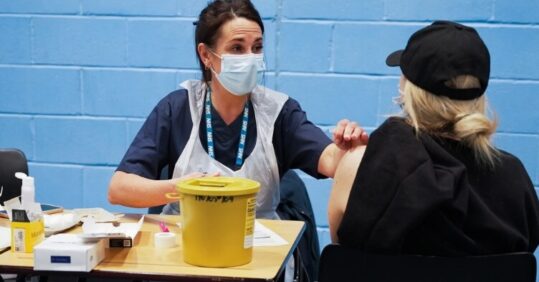
Over 180 nurses and healthcare professionals from Kent Community Health: NHS (KCHFT) were involved in the vaccination hub set up to deliver meningitis B (MenB) jabs after an outbreak in March which caused the death of two young students.
Around 11,000 vaccinations were given in the first week with around 13,000 antibiotics dispensed as well. More than half of the jabs were delivered at the Senate building at the University of Kent from 25 vaccinators and support staff.
Even more work was done outside the vaccination hubs, including reassuring anxious family members, writing letters for global colleagues, linking with devolved administration colleagues, and writing clinical guidance.
Team leaders from the UK Health and Security Agency (UKHSA) and KCHFT have since praised nurses and clinicians for the ‘phenomenal role’ they played, commenting that they could not think of a ‘better example of rapid multi agency working than this’.
Julie Yates, deputy director for immunization programs in UKHSA, told Nursing in Practice: ‘I think nurses in this have played a phenomenal role in all [the] organisations [involved]. I’m very, very proud.’
‘It’s important to acknowledge the efforts of the staff on the ground’
The first cases of meningitis were recognised on Saturday 14 March and several organisations quickly swung into action arranging antibiotics, organising vaccination teams and contacting family members.
Jaime Morgan, principal health protection practitioner for Kent Surrey and Sussex, said they realised early on that ‘something unusual’ was happening and teams needed to find a link between the cases – later identifying Club Chemistry in Canterbury and some University of Kent student’s halls as places some of those impacted had in common.
‘You’re asking about things like gatherings, parties, events, that kind of thing, to try and find that link,’ she said.
‘Then everything on Monday kicked off. By Sunday afternoon, we had the first antibiotic hubs open and it’s important to acknowledge the efforts of the staff on the ground who gave out antibiotics.
‘Antibiotics offers pretty much immediate protection, while the vaccine, which is obviously important, can take a couple of weeks. So, the antibiotics are really vital.’
She added that another key job in the first few days was raising awareness, adding: ‘A lot of those symptoms are very similar to hangovers, so it was about raising awareness [and] getting those antibiotics for close contacts.
Related Article: How a nurse-led community mental health hub is improving patient care and access
‘People on the ground set those hubs up very, very quickly with huge doses of antibiotics – it was extremely impressive, and made our lives very much easier, knowing that people could just rock up and get those antibiotics.’
‘I had never seen anything at this scale’
Meanwhile, Katie Allen, lead health protection practitioner based in Kent, Surrey, and Sussex, was responsible for contacting family and friends of those affected.
‘It certainly knocked me for six the number of cases and the severity of illness,’ she said. ‘I’ve been in the team now for 23 years and I had never seen anything at this scale.
‘We were trying to talk to cases and contacts… we needed to get the information, but we also needed to be very mindful.
‘It was trying to get the information whilst being very mindful of the catastrophic effects that this was having on parents and friends.
‘I’ve never seen a response like it. It was just an incredible response from so many different people.’
Following the antibiotics being handed out, the government decided to open vaccination hubs.
Vaccinations
Vaccines are routinely available to prevent some types of meningitis, including against Meningococcal group B (MenB) for babies, and the MenACWY vaccine for protection against MenA, MenC, MenW, and MenY offered to teenagers in school Years 9 and 10.
However, the vaccine for MenB was only introduced for babies at two months, three months and 12 months in 2015, meaning current students will not have been offered the jab, unless they had it privately.
Due to the outbreak, the government introduced a targeted MenB vaccination programme ‘given the severity of the outbreak’ and as an ‘additional precautionary measure’.
Louise King, an immunisation lead nurse for KCHFT, said it was a ‘complete collaborative effort’ to ensure the vaccination hub was set up by Wednesday, four days after the first case was identified.
‘We were prepping ourselves, we were poised waiting for that call for the vaccination programme to start,’ she said.
‘By 2pm on Wednesday, we gave our first vaccines. We gave just shy of 690 vaccines that first afternoon and then on the Thursday we gave another 1,400 and then on the Friday, we gave 1,800.
‘On the Saturday we gave about 750, with Sunday having similar sort of numbers. By Monday and Tuesday, it dropped off to about 350 and that’s when we closed down a lot of the sites.’
She added: ‘Our staff were working absolutely tirelessly. Everybody has worked above and beyond their normal hours. There was no sort of hesitation and everyone said, “I can give an extra couple of hours. I can work Saturday. I can work Sunday”.
‘Everyone just pitched in and it didn’t feel like hard work at all, because everyone wanted to be there. And we all just had this central goal that we were all just aiming for.
‘Everyone just wanted to be there and doing their part and doing their best.’
Ms King said that the young people receiving the jabs were ‘amazing and positive’ despite waiting in the queue for long periods of time.
‘They were grateful,’ she said. ‘It was just so lovely. We didn’t have any grumbling considering how big the queue was.
‘They all just understood that they just needed to wait their turn and we were going to get to them.
‘It’s just been really, really smooth, well organised. I’m really, really proud of all of our team; administrators, our admin team, our central admin hub – so proud of everybody.’
Related Article: ‘Nursing is not just a career, it has a world of possibilities’
Behind the scenes – ‘that’s the sort of thing that nurses do’
Outside of the vaccinations, nurses were also responsible for several written communications such as clinical guidance.
Ms Yates said: ‘We were responsible for writing letters so that the university could send them out for linking with our global colleagues.
‘We’re linking with our devolved administration colleagues because these students dispersed across the whole of the UK, including the Crown Dependencies Gibraltar, all around the world.
‘So, there’s a lot of communication from our nursing teams and others across all these departments.’
She added: ‘One of the things that had to be done was to design, commission and get printed all of these [guidance] leaflets to be able to deliver them to the vaccination clinic.
‘We delivered 5,000 of those within 12 hours of being asked to do it. That’s the sort of thing that nurses do, as well as at the front end, is the clinical input into the training slides, into the guidance.’
Esther Tabor, a consultant nurse for infection prevention and control, added: ‘There are nurses scattered in amongst a number of [organisations] in a variety of different roles, doing a variety of different things, and it all goes on in the background, behind closed doors.’
She said the outbreak had ‘triggered memories around covid’ and said teams were dealing with questions about lockdowns, self-isolation, social-distancing, and more.
‘So that’s the other part that nursing will play,’ she said. ‘To be able to interpret [national guidance] and keep saying at the right levels to the right people, “this is not covid”.
‘So that that’s really our role. A more scientific basis in terms of how infections are transmitted.’
‘Commitment and collaboration’
Those at the UKHSA have said the outbreak highlighted the ‘commitment and collaboration’ of the several organisations involved.
David Green, a nurse consultant for immunisations with UKHSA, said: ‘I just think everyone has been committed to making this happen, and that’s not just the different agencies, it’s the individuals who make up those agencies.
‘It’s just been a really good example of professional commitment.’
Ms King and Ms Morgan added that it had raised awareness of the importance of immunisations as well as meningitis.
Related Article: More than half of GPNs report working while feeling mentally unwell, finds survey
Concluding, Ms Yates said: ‘I think it’s just recognising that there are a vast range of nurses. Nurses provide the bulk of many professional responses at the frontline but also behind the scenes.
‘It’s hard work, and this has been really tiring, but it’s really rewarding as well. This is primary prevention.
‘There’s a big banner about prevention, rather than secondary care and treatment being a priority.
‘Vaccination is one of the most effective public health interventions. I appreciate there was antibiotics and the rest of the public health response as well, but these things really make a difference, and I’d encourage people to really look at a career in public health nursing.’
–

See how our symptom tool can help you make better sense of patient presentations
Click here to search a symptom