‘Make lung function exciting’: How to deliver a successful spirometry test
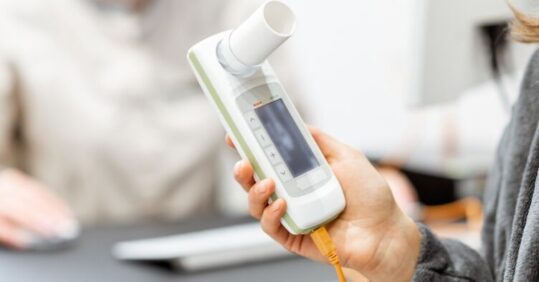


Nurses across primary and community care settings have been urged to consider how to make spirometry more accurate and less daunting for patients, during a recent Nursing in Practice event in Liverpool.
Sophie Toor, founder and clinical director of training and education organisation Respiratory Matters, opened her session with two simple questions for nurse attendees: ‘how many of you actually carry out spirometry in your practice?’ and ‘how many of your patients get it perfect every time?’
Many of the attendees said they did not carry out spirometry and even more stressed the challenge in getting ‘perfect’ spirometry results.
‘What I want to do is shift the idea of perfection,’ said Ms Toor, who is also a respiratory nurse specialist.
‘We always strive to work with our patients to get it right every time, but we must recognise that this is not always possible. So it’s about doing the best we can, every time. And supporting patients to do the same.’
Preparing patients: The foundations of a good test
Before any breathing manoeuvres begin, Ms Toor advised nurses to consider five essential checks:
- Is the equipment clean according to local protocol?
- Has the calibration been verified?
- Has the patient followed the pre-test instructions?
- Are there any contraindications?
- Are the correct patient details entered?
She also highlighted the shift to GLI Global (2022) reference equations, which remove ethnicity as a variable. ‘It’s a really important and long-awaited step toward reducing race-related health disparities,’ she explained.
Then to ensure a quality test, Ms Toor said nurses should consider 10 key points, as outlined in the box below.
What does a quality test include?
- Three good relaxed blows
- Three good forced blows
- The highest two relaxed vital capacity (VC) manoeuvres should be within 150mL of each other
- The highest two forced vital capacity (FVC) manoeuvres should be within 150mL of each other
- The highest two forced expiratory volume in 1 second (FEV1) measurements should be within 150mL of each other
- All three peak expiratory flow (PEF) measurements should be within 40L/min of each other
- In addition the best relaxed VC and best FVC should be within 150mL of each other (unless there is a severe obstructive defect)
- Acceptable flow/volume and volume/time curves
- Flow/volume graphs should show a sharp rise to a smooth contour, and no abrupt stops.
- Volume/time graphs should also show at least six seconds where possible, and a clear minimum one-second plateau.
What if patients can’t complete the test?
Ms Toor stressed the importance of recognising and documenting when standards have not been met, but stressed that often some of the values can still be very useful.
‘Some people simply cannot complete spirometry fully. That doesn’t mean the results are useless,’ she said.
Improving breathing technique
Much of Ms Toor’s session focused on the need for nurses to reassure patients and to encourage them to breathe steadily through their mouth during the test.
When she asked the audience to take a big breath in, almost everyone inhaled through their noses.
‘Patients will do the same unless we guide them,’ she said.
When the audience used this technique they realised how much more air they were able to get into their lungs.
Vital capacity versus forced vital capacity
Ms Toor explained the differences between the relaxed and forced blows. Both need the patient to breathe in fully and exhale completely but as the name suggests the relaxed blow is exhaled at a slow steady pace and the forced blow, hard and fast.
For relaxed vital capacity, she offered a simple sequence: ‘Fill your lungs, pinch your nose, seal your lips around the mouthpiece, and breathe out slowly and steadily gently until everything has gone.’
For forced blows, she again keeping the instructions clear ‘fill your lungs, seal your lips around the mouthpiece and breathe out as hard and as fast as you can right from the very beginning of the blow until you are completely empty’.
‘Spirometry is effort dependent and even health care professionals can struggle to perform a test that meets all the quality assurance standards,’ Ms Toor said.
Nurses should only demonstrate spirometry if they know they can complete it well, or to explain without modelling to avoid confusion, she added.
‘Difficulty performing an accurate test is not necessarily about disease but rather about technique, effort and coordination. Some patients even with severe COPD can perform spirometry perfectly’, she noted.
Coaching as care
Ms Toor likened spirometry to midwifery given its need for reassurance and clear, direct instructions.
Rather than vague encouragement like ‘keep going’, she prefers language with direction and purpose like ‘push, keep pushing that air out’.
She acknowledged that spirometry coaching can be loud, energetic and enthusiastic but emphasised that this energy helps patients feel guided rather than judged.
‘Make lung function exciting,’ she told attendees.
‘Your enthusiasm genuinely helps people give their best effort.’
The latest Nursing in Practice Podcast includes discussion around a keynote speech delivered by the Royal College of Nursing’s (RCN) North West regional director at the same Nursing in Practice event in Liverpool, focusing on the role of primary care and community nurses in tackling healthcare inequities.
In another session from the event, nurses working across primary and community care settings were asked to consider changes and adjustments they can make to their clinics or appointments for patients who are neurodivergent.

See how our symptom tool can help you make better sense of patient presentations
Click here to search a symptom