Lyme disease: what nurses need to know


Lyme disease is the most common vector-borne disease in the northern hemisphere, yet it remains frequently missed or misdiagnosed. Stella Huyshe-Shires, Rachael Pope and Geraldine Piercy of Lyme Disease Action guide clinicians through recognition, diagnosis and treatment – and explain why cases in the UK are set to rise.
Lyme disease or Lyme borreliosis is caused by the bacterium Borrelia burgdorferi. It is transmitted by the bite of an infected tick and is the most common vector-borne disease in the northern hemisphere.1
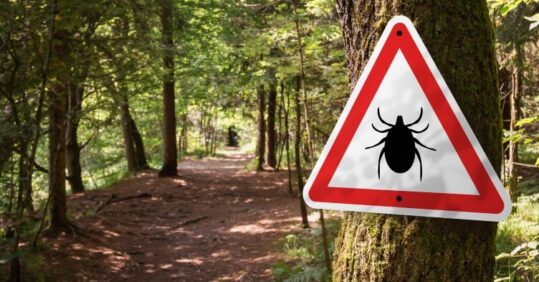
Ticks occur throughout the UK, living in humid conditions, particularly woodland, moorland, and long grass and shrubberies in urban parks and gardens. The larva and nymph stages of the tick cycle feed mainly on small mammals and birds from which they pick up the bacteria.
Adult ticks feed on larger mammals, and many people will have seen adult ticks attached to their pets. The nymph stage, which is most likely to attach to humans, is much smaller than the adult – about the size of a poppy seed, which is why it can go unnoticed.
Ticks are usually found below the waist, but those on small children can be found on the head, neck and around the hairline. The tick attaches with barbed mouthparts and will get larger during the 5-7 days that it can stay attached while feeding.
On first attaching, the tick injects anaesthetic and anti-coagulant compounds, so the bite is painless and initially not itchy. Once it starts feeding blood enters its mid gut and results in Borrelia bacteria being transmitted to the host. The risk of infection thus increases with time, which is why it is important to remove ticks promptly and correctly.
Ticks are most active between March and October, but also on mild winter days.
Epidemiology
Although Lyme borreliosis has been recognised in Europe for over a century, the first confirmed UK case of Lyme disease was in the mid 1980s,2 and the incidence of Lyme disease in the UK has been steadily increasing.3
The majority of ticks in the UK do not carry Lyme disease: spot checks find the prevalence in ticks ranges from zero to about 30% and varies from year to year.4
Cases of Lyme disease have been reported across the UK, with a higher incidence in the southern counties of England and the highlands of Scotland.5 Peak incidence is early summer with a smaller peak in autumn, coinciding with the increased tick activity.
Approximately 2,000 cases are now reported annually across the UK, but these figures represent laboratory-confirmed cases and do not include data from clinically diagnosed cases, or those that may have been missed or misdiagnosed.6,7
Recognising Lyme disease
Early recognition of the disease is crucial as prompt treatment can prevent later complications. However, unless someone presents with an obvious sign of Lyme disease, distinguishing it from other illnesses takes knowledge and patience.
Above all, a conversation with the patient is required to uncover not just current symptoms, but also how the illness started.
Clinical presentation
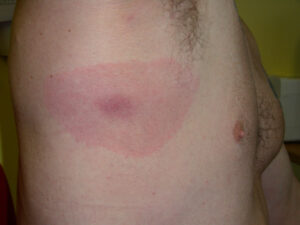
An area of redness may occur as a local reaction to the bite, but this usually resolves itself over 3–5 days. An important early sign of Lyme disease is a slowly expanding annular skin rash called erythema migrans (EM).
On average, EM occurs about 14 days after a tick bite. However, because it may occur in less obvious places, such as behind the knee, it is often unnoticed. The rash can have a ‘bull’s eye’ appearance but may also be homogenously red or bruise-like. The EM rash is usually not hot, itchy, painful or scaly, which helps distinguish it from common skin conditions such as ringworm, infected bites and cellulitis.
Typical EM Rash
People may present with several of the following non-specific symptoms:
- headache
- muscle and joint pains, often fleeting
- fever and sweats
- fatigue
- stiff neck
- paraesthesia
- mild cognitive impairment, often referred to as ‘brain fog’
Health professionals may be alerted to the possibility of Lyme disease by questioning the patient about tick exposure through recreational or occupational activities, or travel to high risk areas, including Europe and northeast USA.
Lyme disease should always be considered when small children present with a facial palsy because they have a higher risk of tick bites in the neck area.8
Later focal symptoms known to be caused by Lyme disease include:
- joint pain and swelling
- neurological symptoms, including unexplained radiculitis and facial palsy
- rarely meningitis, carditis or uveitis
In the UK and Europe disseminated Lyme disease tends to cause neurological symptoms, whereas in the USA Lyme arthritis is more common, usually involving a large single joint, often the knee.
Diagnosis
Early diagnosis is important because early treatment is usually very successful. The National Institute for Health and Care Excellence (NICE) guideline recommends prompt antibiotic treatment of the EM rash without the need for a blood test.9
The routine blood test used by official laboratories throughout the world is Lyme serology. This is an indirect assay of the body’s immune response to infection, and aims to detect antibodies to the Borrelia bacteria. It can take 3-6 weeks for antibodies to develop, so blood tests early in infection may be negative.
If there is a high clinical suspicion of Lyme disease in people without the EM rash, the test for Lyme disease should be offered and treatment with antibiotics started while waiting for test results.
The initial screening test, if positive, is followed by a more specific immunoblot and it is only if this is positive that Lyme disease is confirmed.9
The only direct test of disease is a polymerase chain reaction (PCR) test to detect the presence of the bacteria. This is ineffective on blood, as Borrelia leave the blood stream very quickly, so body tissue needs to be used. This can be skin from a rash, synovial fluid or spinal fluid but the bacteria will not always be present in the sample so it is not 100% sensitive.
There is no test that confirms a cure and serology may remain positive for months or years as the antibodies slowly decay.10
Treatment
Refer to the NICE guideline for detail of treatment, especially in children under 18 years. If left untreated, Lyme disease can spread to other parts of the body especially the nervous system, joints, and more rarely the heart and eyes.9
Adults are treated with oral doxycycline at 100mg twice daily for 21 days, but patients with neurological or cardiac symptoms, or a frank arthritis, should be discussed with a specialist.
Early diagnosed cases usually respond very quickly to treatment, but it is still important that the 21 day course is completed. Some people, especially those diagnosed months after the tick bite, may have a more gradual recovery. If new symptoms appear or recovery stalls, a second course of treatment can be considered with a different antibiotic.
Supporting patients
Patients should be made aware of possible side effects of doxycycline, the most common of which are skin sensitivity to sunlight and nausea – the latter can be reduced by not taking doxycycline on an empty stomach. Some people experience a worsening of symptoms after starting treatment. This is known as a Jarisch-Herxheimer reaction and usually resolves within 48 hours.
Patients may be worried and have many questions based on what they have read on social media. Lyme Disease Action has a reality check page on their website to answer common questions.
It has been found that a small minority of people continue to have symptoms even after appropriate treatment and this is more common in those who have higher depression and anxiety scores.11 Patients should be reassured that the body can take time to re-set after infection with Borrelia burgdorferi.
When symptoms continue for more than six months after treatment completion, the condition is referred to as post-treatment Lyme disease. The cause of this is not yet known but research into this, and other post-acute infection syndromes such as Long Covid, is ongoing.12
Prevention strategies
Awareness of ticks is the key to prevention of disease. Those with frequent tick bites may consider a repellent, or permethrin-impregnated clothing, but should check product labels especially if they have pets.
The most effective check for ticks is to use fingers to run over skin. Any apparent small scab that is found to rock back and forth should be examined closely. Common attachment sites are behind the knee and in the groin, and in small children, at the hairline.
Tick removal showing strong attachment
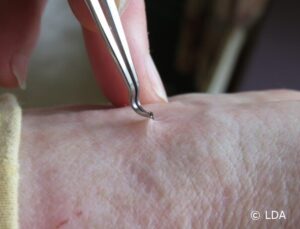
Ticks should be removed with either a tick removal tool or forceps. Household eyebrow tweezers are not helpful as they may squash the body of the tick – increasing the risk of infection.
Future of Lyme disease in the UK
As this bacterium is a relatively new introduction to the UK, it is likely to continue spreading through the wildlife population. Cases in humans are affected by several factors:
- Climate change is leading to warmer winters which will extend the season of tick activity.
- Changes in farming practice to encourage more wild borders to fields may lead to an increase in the small mammals which host the bacteria.
- Moves to increase urban biodiversity in parks also leads to more habitat for wildlife.
However, there are mitigating factors. For example, the increase in UK Lyme disease cases is leading to higher awareness in both health professional and the general public. Additionally, a Lyme disease vaccine is in development and may be of help to people in risky occupations, or visiting high risk areas.
The awareness of health professionals of the symptoms and signs of Lyme disease is critical in achieving an early diagnosis and effective treatment.
Stella Huyshe-Shires, BSc, is chair at Lyme Disease Action; Rachael Pope, MSc, PhD, is a trustee at Lyme Disease Action; and Geraldine Piercy, MVB, is a veterinary adviser at Lyme Disease Action.
A version of this article was first published on our sister title, The Pharmacist.
References
- Strle F, et al. Lyme borreliosis. Nat Rev Dis Prim 2026; 12: 15.
- Williams D, et al. Lyme disease in a Hampshire child – medical curiosity or beginning of an epidemic? Br Med J 1986; 292: 1560–1561.
- Tulloch JSP, et al. A descriptive epidemiological study of the incidence of newly diagnosed Lyme disease cases in a UK primary care cohort, 1998-2016. BMC Infect Dis 2020; 20: 285.
- An update on Borrelia burgdorferi s.l. prevalence and hazard in ticks at recreational areas in England and Wales between 2021 and 2023. https://researchportal.ukhsa.gov.uk/en/publications/an-update-on-borrelia-burgdorferi-sl-prevalence-and-hazard-in-tic/.
- Cairns V, et al. The incidence of Lyme disease in the UK, a population-based cohort study. BMJ Open 2019;9: e025916.
- Common animal-associated infections: 2024. https://www.gov.uk/government/publications/common-animal-associated-infections-2024
- Public Health Scotland. Lyme disease. https://www.publichealthscotland.scot/population-health/health-protection/infectious-diseases/lyme-disease/data-and-surveillance/
- Munro A, et al. High frequency of paediatric facial nerve palsy due to Lyme disease in a geographically endemic region. Int J Pediatr Otorhinolaryngol 2020; 132: 109905.
- Lyme Disease. https://www.nice.org.uk/guidance/ng95.
- Talagrand-Reboul E, et al. Immunoserological Diagnosis of Human Borrelioses: Current Knowledge and Perspectives. Front Cell Infect Microbiol 2020; 1: 241.
- Vrijmoeth HD et al. Determinants of persistent symptoms after treatment for Lyme borreliosis: a prospective observational cohort study. eBioMedicine 2023; 98: 104825.
- Baarsma ME, Hovius JW. Persistent Symptoms After Lyme Disease: Clinical Characteristics, Predictors, and Classification. J Infect Dis 2024; 230: S62–S69.

See how our symptom tool can help you make better sense of patient presentations
Click here to search a symptom