GPNs ‘trying to bridge gaps’ in health check uptake


General practice nurses (GPNs) are working hard to ‘bridge the gaps’ faced by patients with a learning disability or mental health condition who struggle to access care, but funding constraints and pressures across primary care are hampering efforts, a national nursing conference has heard.
It was also argued that wider use of learning disability nurses within GP practices would help to ‘support, educate and strengthen the wider workforce around them’.
The comments came during a debate at the annual Royal College of Nursing (RCN) Congress being held in Liverpool this week, which centred on the need for government support in improving uptake of physical health checks for people with learning disabilities and serious mental illnesses.
‘The pressure on primary care is quite obvious’
In proposing the debate, Rod Thompson, RCN Public Health Forum member, highlighted that the ‘pressure on primary care is quite obvious’.
He made clear he was not criticising colleagues in GP practices, but instead that funding in primary care ‘was not where it should be to allow these procedures to go ahead’.
‘This is a whole system issue,’ he told congress.
Related Article: MenB jab uptake in babies increases but ‘significant’ variation for MMRV, early data shows
‘This is something for all the governments of the UK, and indeed every nurse and every healthcare professional to make a difference on,’ added Mr Thompson.
‘Given the vulnerability of these groups, improving access, uptake, and equitable delivery remains an important consideration for health policy and service planning. Every health professional should be taking this up. Every government should be funding it.’
‘We must speak honestly about the realities of primary care’
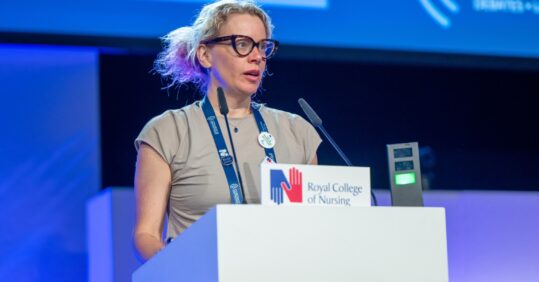
Representing the RCN GPN Forum, lead practice nurse Frances Baverstock stressed that annual physical health checks ‘are not optional extras, they are essential’.
‘But we must also speak honestly about the reality of delivering them in general practice,’ she told congress.
‘Every week within general practice we offer and see patients who want help but struggle to access care.
‘Many miss appointments not because they do not care, but because navigating healthcare can feel overwhelming or inaccessible.
‘Others face digital exclusion, transport problems, language barriers, or profound mistrust of services.
‘As general practice nurses, we try to bridge those gaps.’
Ms Baverstock explained how GPNs ‘make repeated calls, arrange opportunistic appointments, coordinate blood tests, monitor weight and blood pressure, review smoking and medication, chase ECGs, liaise with other health professional, and often provide emotional support far beyond the appointment time itself’.
However, at the same time, demands from the system and the government’s shift to community care, meant primary care was being asked to ‘absorb more and more responsibility’, but without appropriate funding and support.
‘In theory, providing care closer to home sounds sensible,’ she said. ‘In practice, much of this shift has occurred without equivalent investment in staffing, protected time, estates, or community mental health support.
‘Tasks that were once coordinated within specialist services are increasingly falling to already overstretched GP teams, predominantly nurses.’
Related Article: Nearly one person a week diagnosed with TB only after death, study finds
Despite the pressures facing GPNs, the profession ‘continue to deliver compassionate, relationship-based care’.
‘We know that trust matters. Continuity matters. Flexibility matters. Sometimes the most important part of the health check is not the blood pressure reading – it is the fact that someone attended at all and felt listened to,’ said Ms Baverstock.
‘The unique contribution of learning disability nurses’
Sarah Jackson, voting member and chair of the RCN Learning Disability Forum Steering Committee, stressed practice nurses and those working in advanced practice roles ‘can make a hugely valuable contribution to improving access, early identification, and ongoing physical health support for people with a learning disability, serious mental illness, and autistic people’.
But she said she also wanted to highlight the ‘unique contribution of learning disability nurses’ and the support they could bring to GP practices.
‘Learning disability nurses bring expertise in co-occurring physical health conditions, communication, reasonable adjustments, and person-centred care, they are trained to recognise when physical distress or illness may present differently, and to adapt care in ways that improve engagement and outcomes,’ said Ms Jackson.
‘For that reason, learning disability nurses could be ideally placed within primary care to undertake physical health checks, and also to support, educate, and strengthen the wider workforce around them.’
‘Annual and regular health checks key mechanisms’
Also during the debate, Zeba Arif of the RCN Mental Health Forum, recognised the ‘significant health inequalities’ experienced by people with a learning disability and serious mental health illnesses.
Related Article: Nurses hope PMOS renaming will provide ‘fresh focus’ on the condition
‘Annual and regular health checks are the key mechanism to address this issue,’ she told congress.
‘Vulnerability of both groups in improving access is very, very important, and uptake and equitable delivery remains an important consideration for health policy and service planning, it is crucial for us to remember that good mental health and physical health go together.’
The resolution – that this meeting of RCN Congress requests council to lobby UK governments to improve the uptake of physical health checks for people with learning disabilities and serious mental illnesses – was carried.
Other debates this week have been focused on unpaid hours, clinical placement barriers, the ‘growing burden’ of health misinformation, and workplace racism.

See how our symptom tool can help you make better sense of patient presentations
Click here to search a symptom