Nursing in Practice takes general practice nurse pay concerns to Parliament
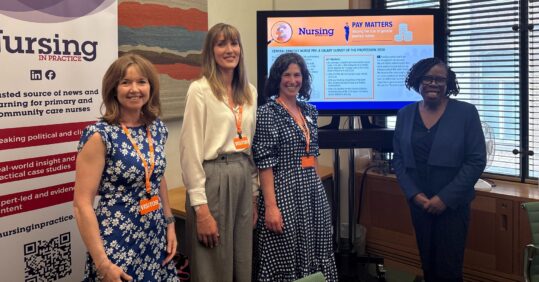


Nurses, MPs and those representing GPs and general practice managers gathered today in Parliament to discuss the issue of general practice nurse (GPN) pay, terms and conditions – and the need for a united approach to improve the situation.
The stark findings of Nursing in Practice’s General practice nurse pay: A salary survey of the profession 2026 report – including that GPNs are earning thousands of pounds less than their NHS Agenda for Change counterparts – was the focus of an MP drop-in today.
Nursing in Practice editor Megan Ford and Royal College of Nursing (RCN) England director Patricia Marquis addressed attendees, outlining key findings of the report and the need for action from government to support the sustainability of the general practice nursing workforce.
Attendees heard how around a third of GPNs did not receive a pay rise for 2025/26 and that 32% are looking to quit the profession in the next 12 months, largely because of pay and feeling undervalued. They also discussed how only 5% of GPNs are being offered above statutory maternity pay and how just 32% are receiving above statutory sick pay, as per the data findings in our report.
‘General practice nursing is the backbone of nursing’
MPs in attendance included interim chair of the Health and Social Care Committee and Labour MP for Birmingham Erdington, Paulette Hamilton, who said our report findings – based on a survey of almost 900 GPNs – were ‘shocking’.
Ms Hamilton, who is a district nurse by background, said: ‘I’ve been a nurse for 25 years, and general practice nursing is the backbone of nursing.
‘If we’re moving towards primary care and we’re saying we want to do more out there in the community, that’s where we are going to really value these nurses.’
She added: ‘The findings today that I’ve read and what I’ve seen around pay and conditions… are absolutely shocking.’
Ms Hamilton said now was the time for the government to work with the RCN and others to ‘ensure that practice nurses are treated like equal partners and not like a cousin once removed’.
‘It’s not good enough, and it does need to change, and it does need to be highlighted, because they are so important, and they will really help towards what we’re trying to do with that 10-year [health plan].’
Related Article: Report highlights impact of nature-based projects led by community nurses
‘We’ll continue to bang the drum for GPNs’
The event and report were supported by Liberal Democrat MP for West Dorset, Edward Morello, who said he wanted to ensure ‘the vital role’ of GPNs was understood more widely.
‘I’m glad to see this report has come out and it is highlighting a lot of the issues that we’ve been talking about,’ he told MPs.
‘I think what we need to make sure that people out there understand the vital role that general practice nurses play in our NHS within our GP surgeries, and actually the unfairness that’s within the pay system, and that is not reflecting the hard work and the effort and the vital service that you provide.’
He added: ‘We’ll continue to bang the drum for GP nurses, because it is vital and there needs to be more fairness in the system.’
‘Practice nurse pay a longstanding inequity’
Labour MP for Sittingbourne and Sheppey and a former nurse, Kevin McKenna, also attended the event, warning that the issue of GPN pay ‘has been a longstanding bit of inequity in the health system’.
‘It does need to be resolved. It’s a big inequity across the system, and it impacts on workforce modelling, who can access where, but most of all, it impacts on the wellbeing of the staff in the NHS at a time that we really, really need to boost that,’ he said.
MPs in attendance, which also included Rachael Maskell, Labour and Co-operative MP for York Central and Andrew George, Liberal Democrat MP for West Cornwall and Isles of Scilly, spent time discussing the issues around pay and workforce pressures with GPNs who called for increased support from the government.
The report sets out three core recommendations, including the need for ringfenced funding in general practice nursing and for the nursing voice to be included in general practice negotiations. It also demands pay alignment for nurses in general practice with Agenda for Change.
‘General practice nursing needs a seat at the table’
RCN England director Ms Marquis said in her address that nursing needed ‘a seat at the top table’ when it comes to general practice funding.
She warned that GPNs were ‘regularly left out of discussions about the NHS’ and that ‘politicians tend to turn their focus on hospitals on A&E when we talk about things like corridor care’.
‘But the reality is that our general practice nurses are part of the solution to the challenges that all of these places face,’ she said.
‘Most people, including MPs, assume our general practice nurses are in the NHS in the same way nursing staff working in hospitals are.
‘They assume they have the same pay terms and conditions. They assume they automatically get sick pay and maternity pay. They assume they will get a pay rise every year. They assume when the government provides the money to employers for a pay increase that it will be passed on.
‘None of these things, most of you know, are true, and it’s hitting hard in general practice – those the government are turning to for the delivery of care closer to home are being desperately let down and left behind.’
‘Investment in GPNs must move beyond rhetoric’
RCN GPN Forum vice chair Penny Sibthorp added that the situation around practice nurse pay, terms and conditions was ‘alarming’.
‘Given all the changes that are coming into primary care with the left shift, we can see how practice nurses are pivotal within that,’ she said.
‘And as we are so pivotal, the concern is that, is our workforce as it stands sustainable and able to fulfil that? And sadly, at the moment, I’m not sure that it is and the Nursing in Practice report reflects that, in terms of the number of people that are considering leaving.’
Related Article: MenB jab uptake in babies increases but ‘significant’ variation for MMRV, early data shows
She added: ‘If the NHS is serious about further expanding care in the community, then investment in the general practice nursing workforce must move beyond rhetoric.
‘We need fair and consistent pay, greater alignment with Agenda for Change principles, protected professional development opportunities and meaningful nursing representation in national workforce and contract discussions.’
Meanwhile, advanced practice nurse and trainee coach Anna Young called for a structure that ensured GPNs were guaranteed annual pay uplifts and good terms and conditions.
She warned that poor pay, terms and conditions were ‘stopping people from coming into primary care’ and meant that others were leaving.
Also attending the event was research fellow and registered nurse Dr Helen Anderson, who warned of ‘numerous issues’ around the GP contract and around ‘power imbalances and around nurses’ voices not being heard’.
‘Something really needs to change about that,’ she warned.
The event saw GP and practice manager representatives discuss with GPNs and MPs the need for a collaborative approach in addressing funding and pay issues within general practice.
They warned against focusing solely on general practice nursing pay and to widen up the conversation to focus on core funding for GP practices that could be spent on pay, terms and conditions for all general practice staff.
Dr Sarah Jacques, co-GP lead for the Doctors’ Association UK (DAUK), said: ‘If we can fund the entire team properly, then we can look after all of our team members, and we can have better retention, better sustainability, and we can produce better patient care.
‘I think there needs to be a better understanding of how general practice is actually funded and the understanding of what our independent contractor status is compared to other private providers.’
Kay Keane, chair of the Institute of General Practice Management, said the findings of the report were concerning because ‘general practice nurses are a vital part of the team delivering care to patients every day and we must take seriously any issues that affect recruitment, retention and morale’.
Related Article: Hundreds of new nurses and midwives not offered NHS roles due to lack of vacancies
However she also warned: ‘We need to avoid viewing workforce challenges through the lens of a single profession. General practice succeeds because of the collective contribution of many professional groups including nurses, GPs, practice managers, reception and patient services teams, healthcare assistants, pharmacists and others.
‘The future of general practice depends on recognising and valuing the whole multidisciplinary team. We cannot solve workforce challenges by addressing one profession in isolation while overlooking the pressures facing others. Sustainable solutions require professions to work together, speak with a united voice and focus on what is best for patients and the future of general practice as a whole.’
Ms Keane further said that workforce challenges cannot be separated from the wider funding of general practice.
‘If we want to retain skilled professionals, develop services closer to home and deliver on the ambitions for neighbourhood health, we need long term investment in the whole primary care workforce and the infrastructure that supports it.’
The General practice nurse pay: A salary survey of the profession 2026 was first officially launched at a Nursing in Practice event in London in April.

See how our symptom tool can help you make better sense of patient presentations
Click here to search a symptom