‘Nursing is science in action’: nurses push for better recognition of profession


Nurses are pushing to be recognised as a Science, Technology, Engineering, Arts and Mathematics (STEAM) profession – to reflect the evolution of the role and the ‘greater responsibility’ it now carries.
Nurses from across a variety of settings joined a debate in Liverpool last week to showcase how the profession uses science, data, technology, maths and more within everyday practice.
The discussion at the RCN’s annual congress was initially focused on recognition of nursing as a Science, Technology, Engineering, and Mathematics (STEM) profession, before being changed to a voted-for resolution which also included the recognition of the ‘arts’ in nursing.
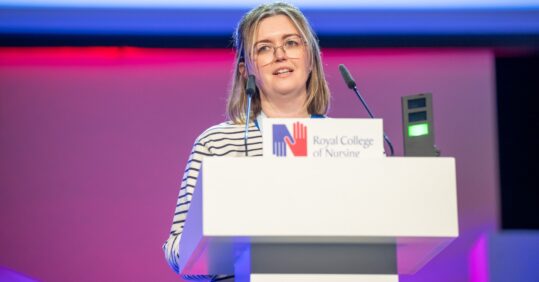
Charlotte Collings, chair of the RCN’s Eastern region, led the debate and highlighted how STEM ‘isn’t something separate from holistic, person-centred care’. ‘It underpins it,’ she said.
Ms Collings explained how nurses now qualify with a bachelor’s or master’s degree in science, and that strong science and maths skills are required to even begin nursing training.
‘And we rely on nurses to use that knowledge throughout their careers,’ she added.
Related Article: Report highlights impact of nature-based projects led by community nurses
‘Nursing practice is built on judgement, analysis, [and] decision-making wherever care is delivered.’
Ms Collings added: ‘We don’t stop being nurses when we use data. We don’t lose compassion when we think analytically.’
Importantly, she said that how nursing was described ‘shapes how it is valued by the public, by policymakers, and the systems we negotiate with’.
‘Nursing has always been skilled and professional. Recognising the STEM in nursing doesn’t create that value, it amplifies it, it strengthens how our expertise is understood, supports professional identity, and gives the profession a stronger footing in conversations about opportunity, investment, and rewards,’ said Ms Collings.
‘This matters because nursing is a profession dominated by women, and as a result, its expertise is too often undervalued – described as caring or instinctive, rather than acknowledged as skilled, technical, and analytical.’
Adult nurse and RCN member Olive Ngerem-Sales joined the discussion and warned of ‘outdated stereotypes’ that exist around nursing.
‘Look around this room – every single day, nurses are making critical split-second decisions that save lives,’ she said.
‘Yet outside our profession, a lingering, outdated stereotype exists. “They are just nurses”.’
She added: ‘Nursing is not just adjacent to science, it is science in action.’
Abby Swindal, member of the RCN’s Digital Nurse Forum, agreed that nursing is ‘undeniably grounded in science’.
Related Article: MenB jab uptake in babies increases but ‘significant’ variation for MMRV, early data shows
‘Every day we look at technology, we use our analytical reading, and we are a profession that is critical to safety of our patients and those we care for,’ she added.
‘Our contemporary practice relies on us to interpret complex data, apply pharmacology, engage with digital systems, and contribute to research and quality improvement.
‘We use population health insights to ground our work. We use digital platforms to document pretty much everything that we do for our patients and people we care for, and we are behind emerging technologies to inform safe and effective care.’
The lack of recognition of nursing as a STEM career has implications for how nursing is ‘perceived’ and ‘how it’s funded’, warned Ms Swindal.
Adult nurse and RCN member, Laura Courty, took to the stand to highlight the arts aspect of nursing.
‘Whilst I see a lot of value in thinking of nursing as a STEM background, it’s important it perhaps is reframed to STEAM,’ she said.
‘STEAM includes the arts, and nursing, at its core, is an art.
Related Article: Hundreds of new nurses and midwives not offered NHS roles due to lack of vacancies
‘We don’t just work with technical, science-based thinking. We use our soft skills, we use our emotional intelligence, and we constantly work creatively to support our patients, and no other profession does that in quite the same way we do as nursing.’
Closing the debate, its proposer, Ms Collings added: ‘Nursing has evolved since its acknowledgement throughout history, and with that evolution has come with greater responsibility on us as individuals in this career. It’s only right that we get the recognition that we deserve as a STEAM profession.’
Members from across the RCN voted for the union’s governing council to lobby for nursing to be seen as a STEAM profession in a move that they hope will help to amplify the recognition of nursing.

See how our symptom tool can help you make better sense of patient presentations
Click here to search a symptom