
CNO calls for greater community care exposure for hospital chief nurses and students
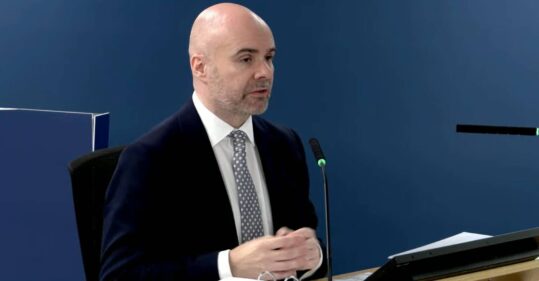


England’s chief nursing officer (CNO) has urged hospital chief nurses to spend time out with their community colleagues to help improve understanding of the sector and its demands.
He also reiterated the need for increased placement opportunities within community settings for nursing students, as the government looks to shift more care out of hospitals.
Duncan Burton, who was speaking at the annual NHS ConfedExpo being held this week in Manchester, pinpointed the need for ‘better understanding’ between community and secondary care, through increased exposure to, and placements within, community settings.
‘We talk a lot about the shift from hospital to community. We do not provide enough training for our student nurses in community settings at the moment,’ said Mr Burton.
‘We’ve got to change that. That’s the only way we’re going to do this. We still hear too much of “you can’t start your first job as a newly qualified nurse in any way other than a hospital”.
‘That’s nonsense. We’ve got to break through that.’
Related Article: Nursing in Practice returns to Scotland with CPD event this September
He added: ‘I would encourage [colleagues], and I know many of my hospital chief nurses already [do, to] spend time out with their community colleagues.
‘Let’s create that understanding… it’s really important.
‘The way we educate and train our future nurses has to be with time spent in community settings because I think unless you do, you don’t understand the complexity and the great career opportunities that are available for people.’
On Wednesday, chief executive of NHS England Sir James Mackey also mentioned the need for a ‘better balance’ between primary and secondary care, stating neighbourhood health plans have been made ‘overly complicated’ because of a divide between the two.
Speaking also at this year’s NHS ConfedExpo, he stressed the importance of jointly working together, directly linking it to hitting elective objectives and improving urgent care performance.
The CNO also highlighted that, as well as training and placements within the community, there are also vacancies within social care in the independent sector.
He stressed its important for nurses to experience different roles and for the government to ‘open the doors’ to enable them to find employment in these settings.
‘It isn’t just all about the NHS, we’ve got vacancies in social care, in the independent sector,’ he said.
‘So this is why it’s really important that we change our approach as a profession to how important it is to have experiences in other parts, and those are great experiences, great places to start your career.
Related Article: New QICN faculty and network for health and justice nursing
‘So that’s some of the work that we’re doing with students that qualify in this year about how do we open the doors to other settings to be able to provide jobs.’
This comes as the Nursing and Midwifery Council (NMC) is midway through its consultation on practice learning, one proposal including the requirement for nursing students to complete at least one community practice learning experience.
The regulator has recently appealed for more people – especially midwives, nursing associates and people from Black, Asian and ethnic minority backgrounds – to complete its consultation before it closes on 23 July.
‘ANPs are fantastic roles’
During his talk at NHS ConfedExpo, Mr Duncan also positioned advanced clinical practitioners and advanced nurse practitioners as a way to keep senior nurses and other clinicians at the bedside, improve patient experience, and reduce waiting times – dubbing the roles as ‘fantastic’.
This comes as the British Medical Association (BMA) has recently written to the health secretary calling for ‘urgent action’ on its concerns over what it has called ‘unsafe and dangerous substitution of doctors’ by advanced practitioners (APs).
Following a survey of BMA members earlier this year on concerns around ‘inappropriate blurring of the distinction between doctors and non-medically qualified staff’, the association revealed doctors have ‘widespread fears for patient safety over the chaotic way employers use APs in the NHS’.
In the survey, the BMA states there have been ‘concerns’ about ANPs for ‘some time’, suggesting ‘employers use ANPS as doctor substitutes on medical rotas’
Related Article: Reframing eating disorder recognition in primary care
The CNO said: ‘I’m also really keen that we find ways to keep senior nurses with patients longer, and I think roles such as advanced clinical practitioners, advanced nurse practitioners are fantastic roles.
‘Not only for nurses [and] midwives, but also allied health professionals, because actually this retains those experienced senior clinicians with patients and provides amazing opportunity to improve the experience, reduce waiting times, etc.
‘So we’ve got to keep making more of those opportunities.’

See how our symptom tool can help you make better sense of patient presentations
Click here to search a symptom